Showing posts with label Tuscany. Show all posts

Sunday, January 10, 2010

The Proof Of The Pudding Is In The Eating


I don’t expect to find any surprises in liquor stores with drive-through windows.

That’s why I prefer to buy wine in big city mega-stores. The little local suppliers around here cater mainly for the below average or mass produced well-known wines. I guess that’s to be expected if half the store space of these smaller stores is devoted to beer, hence, the drive-through window.

If you out shopping there is probably nothing that gives you a bigger kick than to find something that you like or would like to have and at a bargain price. This happens a while ago when I had an hour or two available to slowly cruise the aisles of a big liquor store in Lexington. I came across a Petrolo “Torrione” Toscana 1998 for below $25, marked down from $46 because it was the last in the bin. And there was little chance on them getting anymore because only 38,000 bottles were made that year.


The Fattoria Petrolo (above) with its famous winery is located on a slope of the Aretini hills that overlook Tuscany’s Chianti region. The estate is about 1 kilometer away from the towns of Mercatale Valdarno and Bucine, 30 km northeast of Siena, and 40 km southeast of Florence. The farm, which also produces sought after Extra Virgin Olive Oil, was part of the medieval fiefdom of "Galatrona" and its tower (torrione in Italian), built in the 12th century atop Roman ruins, still exists and is featured on all the labels of the winery’s wines. The winery makes just two red wines: “Galatrona” a pure 100% Merlot and “Torrione” a pure 100% Sangiovese. Furthermore, the winery specializes in small batch production where quality is far more important than quantity. In general they produce only about 3300 cases a year of “Torrione” and even fewer cases of “Galatrona”.

So why was I so excited to find a Petrolo wine? Petrolo wines are nearly always rated in the 90’s out of 100 on the wine rating indexes. And nearly all highly rated wines like that are normally out of my financial range from a non-special occasion prospective. For example, the 2007 “Torrione” has just been named as one of Wine Spectator’s top 100 wines of 2009 with a 94 rating, and the “Galatrona” 2004 is rated at 97/100. Of course, at the time of buying this specific bottle I had no idea what the 1998’s rating was, I simply bought it because it was a bargain price for a Petrolo wine. Nor am I really someone that cares that much about wine rating in general, because it’s another man’s taste description of the wine. Each person has its own likes and dislikes in wine, but I would agree, it could be useful in giving you some idea of what others think about it, when buying wine, especially if it is a foreign language label.


The Galatrone tower on the hill above the vineyard

When I recently made a Greek leg of lamb with rosemary-garlic roasted potatoes the culinary occasion was favorable to open the Torrione. It had a little sediment, not unusual for an old wine, and there’s nothing wrong with sediment, but I nevertheless poured it through a wine filter/”sediment catcher”. The color was deep, dark red, nearly garnet, turning purple at the glass’s edge. But that’s unfortunately where the good part of the story ends.

I am not one that can or would really like to describe wine in some of those imaginative words like muscular, energetic, racy, big-boned, easygoing, lively, poised, graceful or angular (what the hell is that?), but I do understand the terms flabby, tinny, bitter after taste, even thin/lean as oppose to full-bodied. All of the last mentioned terms applied to the Torrione. The wine was a disappointment! I expected a full-bodied, smooth drinking or supple wine with soft tannins and intense aromas. What I got was a dry, nearly harsh red wine that tastes like any other cheap, mass-produced red wine, sold in gallon bottles (ses-man kanne) and through drive-through windows, and at best, drank after it was in a refrigerator for a day or two.

Did I buy a bad bottle of wine or a bottle of bad wine? Sangiovese, famous for being the heart of Chianti, Brunello and many super Tuscan wines, is a difficult grape to grow and even more problematic to turn into a good varietal wine. Many wine lovers either loves it or hate it as a varietal, but when it is done right the grape's soft tannins, tasty acidity and moderate to intense blackberry and cherry flavors make Sangiovese very easy to drink and a versatile wine at the dinner table. When in Italy and at home I have tasted many good Sangiovese wines and because Petrolo’s other vintages of Torrione are highly rated by experts and the fact that I found during the research of this post that both Wine Spectator and Wine Advocate magazines gave the 1998 Torrione 89 out of 100 rating, I have to conclude that I bought a bottle of bad wine and not a bad bottle of wine. It probably overheated at some point in time, or was badly transported or was stored for a long period at uncompromising environmental conditions.

To use clichéd expressions, wine is like a book that should not be judge just by its cover; the proof of the pudding is in the eating.

Friday, August 8, 2008

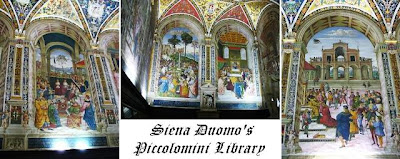
Cathedral of Siena's Piccolomini Library

Heading picture: The Fonte Gaia, Fountain of Joy, on Siena's Piazza del Campo.

Some of the most colorful frescoes we saw in Italy were in the Cathedral of Siena in the Piccolomini library. The bus trip to Siena and San Gimignano had many ups and downs. The biggest damper was the rain. Secondly, the whole day tour was too quick. Too many distractions. You need time to really appreciate San Gimignano and Siena. It was the cities where you could easily step of the tourist route, stroll down a narrow alley and step back into time, back to the Middle Ages. Standing in the middle of Piazza del Campo consuming every drop of the surrounding architecture, recalling the history, one can almost hear the noise of people and horses on a Palio Saturday.

Nevertheless, there were highligths too. In San Gimignano I took 20 minutes to step off the well beaten path and explored some quiet alleys and the towers. Another highlight was the Piccolomini library. The vivid colors, coming from a darkish cathedral into the brighter library makes it so much more striking.

The library was commissioned in 1492 by cardinal Francesco Piccolomini Todeschini (then archbishop of Siena and later pope Pius III) for the humanists texts and manuscript collection of his uncle, cardinal Enea Silvio Piccolomini, who was Pope Pius II. The frescoes were executed between 1502 and 1507 by the Perugian painter Pinturicchio and his assistants.

Pius III never actually saw the end product and the collection never made it to the library, because he died in October 1503, only 26 days after he was elected pope. He died of an ulcer in his leg although some believe he was poisoned by the governor of Siena. It was turbulent times in Rome and in Italy at that point in history, during the last days of the papacy of Alexander VI, who was one of the most murderous popes ever and from a family steeped in vice and crime.

The early beliefs of humanism were that, although God created the universe, it was humans that developed and industrialized it.

In the middle of the library is a copy of the famous statue Three Graces.

The frescoes depict ten important events in the life career of pope Pius II. Interestingly, Pinturicchio painted himself in several of the frescoes. I guess he reasoned that the person who commissioned the frescoes was deceased and couldn’t complain, so what the heck, why not put myself in it too.


Scene 3: Piccolomini being crowned as court poet by emperor Frederick III

Scene 5 and 6:

Scene 5: Piccolomini, then bishop of Siena, presents emperor Frederick III with his bride-to-be Eleanora of Portugal at the Porta Camollia in Siena.
Scene 6: Piccolomini receives the cardinal's hat in 1456.

Scene 8: Piccolomini, as Pius II, convokes a Diet of Princes at Mantua to proclaim a new crusade in 1459.

The library's ceiling.

I don't know the aritst or paiting's name, but liked the overall picture and colors, especially the glow they came from the colors. Siena Cathedral.

Thursday, July 12, 2007

Field of Miracles

Today, Thursday, the term “Slow travel Italy” was at the order of the day. This was the start of a vacation within a vacation. The plan was to enjoy a few less hectic days at the coast in the region of Liguria, Italy’s Riviera coast. We had no fix plans for the next 3 days except that we wanted to stop for a few hours in Pisa, spend some time visiting Cinque Terre and on Sunday we have to be on a train to Venice. One uncertainty in the next 3 days was that the coming Saturday was a national holiday in Italy, Republic Day, and we weren’t sure what was open for visiting and what trains or services were operating on a national holiday. Maybe we will go into Genoa for a day or maybe we will just cruise the coast line. Our base was to be an apartment on a small farm, an Agrituristica settlement, up in the mountains overlooking La Spezia and the Bay of Poets. It was kind of a nice not to follow a rigid timeline for a change. But our first stop before we left the Tuscany region was Pisa, an hour’s train ride west of Florence.

Arriving at Pisa we discovered there was a taxi strike in progress so we quickly had to figure out which bus to take to the Campo dei Miracoli (Field of Miracles) or the Piazza del Duomo to visit the Baptistery, Cathedral of Pisa and the Campanile (the ‘Leaning Tower’) next door. The group of buildings (including the cemetery), is a UNESCO World Heritage site since 1989 and are fine examples of the Pisan-Romanesque architectural style. After entering the site through a castle-like entrance, the white buildings contrast strikingly from the expanse of green grass that surrounds the buildings. We purchased entrance tickets for the Bapistery and the Duomo. The first availble timeslot to the tower was 2:00 PM and our scheduled train was to leave around that time so there was no time to go up the tower. The baptistery, which was begun in 1152 is very bare inside, but with incredible acoustics. The impressive acoustics were illustrated by a woman who sang some kind of hymn while we were inside. The Duomo, begun in 1064, is not as minimalist as the Duomo of Florence on the inside, but not as opulent as St. Peters. Unfortunately, many of the Duomo’s original medieval artwork were destroyed by a fire in 1595. Luckily some important works did survived. And then there is the Leaning Tower, a miracle that it actually still stands after its foundations began to sink shortly after building commenced. By the way, Pisa’s Leaning Tower is not the only leaning structure in the world. There are actually several. Click here to see a list of leaning structures in the world.

We caught the bus back to the train station, where I had to jump a long line (queue) at the luggage depot to get out luggage, no doubt angered some people in the line, but if I didn’t we would have missed our train to La Spezia. The closer we got to La Spezia the more overcast the sky got. Upon arrival we had a late lunch at McDonalds at the station before we took a taxi (luckily there was no strike in La Spezia) to our apartment in the mountains. Later the evening it started to rain and the weather forecast for the next two days predicted intermittent rain, not something we wished for while on holiday.

That evening we had a basic, but excellent dinner with the host of the agriturismo where we were staying. It was a simple dinner of Mediterranean salad and pasta (penne with a tomato and tuna sauce.) We finished it off with a bottle of DOC white wine produced on the premises and ended the evening with Espresso and Grappa. In my next post I will tell more about the agriturismo concept and about our specific farm, La Cicala.


Entrance/Exit of Pisa's Field of Miracles.

Pisa's Campo dei Miracoli. The Baptistery on the left, the Duomo in the middle and Campanile (The Leaning Tower) at the back.

Pisa's Baptistery is the largest in Italy. Look at the roof. It is half tile and half lead. The lead faces the seaside and the tiles the inland side.

The Duomo. Although the architecture is distinctive Pisan-Romanesque, the pointed arches reflects a Muslim or Byzantine influence. The Mosaics inside also points to a Byzantine influence.

The Duomo's ceiling. The original ceiling was destroyed in the the fire of 1595. This gilded ceiling was erected after the fire.

Inside the Duomo of Pisa. It is quite a lovely church, both inside and outside with a very impressive entrance door (not in use anymore) and in need of a clean up. Compare to many other churches in Italy, there is a lot of light inside the church.


The spectactular dome and mosaics of Pisa's Duomo.

The Duomo's Pulpit. This is a masterful piece of art. The detail on it is amazing. But get this. The pulpit must be about 12 feet high and about 10 feet in diameter (look again at the earlier picture of the Duomo's inside.) After the 1595 fire the pulpit, which survived the fire, was stored away while they were repairing and redecorating the Duomo. Then it was rediscovered in 1926 and re-erected inside the Duomo. How on earth do you lose something like this and then rediscover it 331 years later? Where did they store it that no one knew about it? On the other side of the earth? Didn't anyone miss it all this time? It must have been recorded that it once had a beautiful pulpit and whether it was destroyed in the fire ot not.


The Campanile or bell tower, more commonly known as the "Leaning Tower of Pisa".

Monica doing her best to hold the tower up, but to no avail.

Wednesday, July 11, 2007

Renaissance Art and the Art of Shopping

Buon Giorno!

Day 9 was dedicated to art and shopping. Can’t come to Florence and not shop! But first the art part. I know Florence is a big Renaissance city, but certain art just don’t excite me much, namely pre-Renaissance religious art, or art from the high Middle Ages, art prior to 1400. In the morning we visited the Museo degli Uffizi, Italy’s most glorified museum. There were some really fantastic paintings and sculptures in the Uffizi. Botticelli’s “Birth of Venus” is certainly the highlight. It is just a pity it was behind a sheet of clear glass, making it look like you watching it on TV. But being surrounded by 18 Botticelli's in one room, among other the Primevera, is quite something. Michelangelo, Da Vinci, Raphael, Caravaggio, Giotto and many others were also on show. All in all, the Uffizi has a very good, complete art history of the Renaissance period in Italy. I am more of a modern art and Impressionist art lover, but during our trip I really started to appreciate Renaissance art. If I have learned nothing from our Italian trip, at lease lI learned to appreciate the work of Renaissance artists.

In the early afternoon we visited the Dell’Accademia, but apart from Michelangelo’s David, there was not much to look at and in my humble opinion, give the Dell’Accademia a skip. It was downright disappointed and a total waste of money. There are more masterpieces on the Loggia, for free, than in the Accademia. We should have spent the €46 entrance fee (for 3 persons) on more shopping. Thank goodness we did not have to wait in any of the loooong lines at these museums. I used the Internet to reserve timeslots at the museums and bought tickets 5 weeks in advance.

In between the museums visits and afterwards, we dedicated our time to sightseeing and shopping at a very leisurely pace. We journeyed the narrow medieval streets, passed Dante’s house, or where they think it was, walked through many piazzas: Repubblico, Di Maddonna Degli Aldobrandini, di Santa Maria Maggiore, di San Giovanni (right) and several more. We had lunch just behind the Piazza Del Mercato Centrale, was serenaded by two gentlemen playing the “trekklavier”, accordion, and typical Italian music, while we did people watching: a television crew interviewed a local shop owner, a baker delivered fresh bread to the restaurants, Italian workers scurried from point A to point B in their lunch hour, a garbage truck made his appointed rounds, tourist casually strolled from attraction to attraction and other people like us, sat at lunch tables, waited for their food and did people watching.


I popped in to the Mercato Centrale, a massive marketplace for meat, fish, fruit, vegetables and other delicacies. We browsed and shopped at the street vendors on Via San Lorenzo where they sell anything from t-shirts to leather goods. We even had to buy an extra suitcase, a Louis Vuitton look-alike, for all the extra purchases. The road home took us down Via Del Ciglio and through the very narrow, medieval Via del Moro to Piazza Carlo Goldini and on to Borgo Ognissanti. I did not take many pictures today, but rather experienced Florence by the naked eye. However, I did take several of the “Picture Paintings” you will see on the blog on the Via San Lorenza.

It was really enjoyable and mind-blowing to walk these narrow, cobble-stoned streets, sharing it intimately with tiny cars, scooters, motorbikes and bicycles, especially coming from the new world with its wide boulevards, big gas-guzzler cars, strip malls on the edge of town and wide open spaces. Rome (to a lesser degree), Naples and now also Florence, are compacted, noisy, hectic, crowded and very exciting, but also very strenuous on the feet and on the senses.

Florence, for all its beauty, history, its art and architecture, also has its down side. It is packed with tourists and according to our experience, by far the most expensive city in Italy. Example: A pizza in Naples and Rome would be €7 to €8, but in Florence it is €13 to €15. Our accommodation in Florence was also the most expensive in all of Italy. But there are gems to be discovered like the Osteria Il Mostrino. Nevertheless, Florence was great! And we may have to revisit because 4 days was just not enough. There was no time for visits to the Basilicas Santa Maria Novella or the Santa Croce and except for a brief visit to the Palazzo Pitti we never explored the south side of the city. When in Rome do like the Romans do and when in Italy a visit to Florence is a must.


Michelangelo's David. Certainly the most referenced piece of art in Florence, if not in Italy. Eventhough picture taking inside the Dell'Accademia is strictly forbidden, I snapped three of David while the gallery staff was telling others not to take pictures.
The central square of the Uffizi. Standing in the centre of the square, one can rightly say: I am now surrounded by so much art that no money in the world can buy.

Florence's skyline with the Ponte Vecchio in the foreground. I took this picture from one of the windows overlooking the Arno River in the Uffizi Gallery.

Monica shopping for souvenirs and presents for ourselves and friends on the Piazza della Signoria after our visit to the Uffizi.

Entrance to the Via dell'Ariento and the street vendors around the Mercato Centrale (Central Market) with the Basilica di San Lorenzo in the background.

The Basilica di San Lorenzo, one of the largest churches in Florence. It is the burial place of all the principle members of the Medici family and it was also the parish church of the family.

Sunday, July 8, 2007

Architectural Florence

The Palazzo Pitti, is where the de Medici and later the Austrian House of Lorraine, when the de Medici line became extinct, ruled from for more than 2 centuries. For a short period Napoleon Bonaparte used it, before it was passed to the House of Savoy and later the King of Italy during the different waves of invasions of Florence. The palace is enormous and very opulent. None of the British castles and palaces we visited last year has been this opulent. I must say though, the palace’s façade is plain and dull compare to the inside. It is more fortress-like than palace, in the Roman rustica, antica style. Nevertheless, it stood the test of time and the design was copied through the ages and it is very similar to the Palazzo Medici-Riccardi also in Florence.

Palazzo Pitti façade

The palace’s ceilings are beautifully painted and the art collection is huge. The paintings in the Palatine Gallery covers from the 15th to the 17th century and is in general nearly all very good, especially the paintings by Raphael. My favorite was his La Donna Velata (The Woman with a Veil.) All the rooms are decorated in different periods and one could get a fantastic idea what was fashion at the time or how luxuriously these people lived. Most of them are as the de Medici left them. In one area Napoleon built a new bathroom but he never used it once. Unfortunately you will not see any pictures because cameras were not allowed.

The palace though, just like most of Florence, is very expensive. Entrance to just the Palatine Gallery was €11.50 per person. Then to see the costume gallery (only about 12 costumes) and the Boboli gardens is another €9.00 per person. A cappuccino in the cafeteria is €4.00.


Palazzo Petti - A side entrance.

From the Palazzo Pitti we walked back across the Ponte Vecchio, stopping at the Marcato Nuovo (the new marketplace) where I bought an apron depicting landmarks of Florence, and rubbed the nose of the wild boar bronze statue for good luck. (Left). We walked further north to Piazza Di San Giovanni, where we found one of the landmarks of Florence, Duomo and Baptistery. From the outside the Duomo, the Cathedral Santa Maria del Fiore, is magnifico with its green, pink and white marble, and it is huge. (It is Europe’s 4th largest church.) The cathedral was started in 1296 and eventually completed in 1436. The massive octagonal cupola, build between 1420 and 1436 and which dominate not just the church, but also the Florence skyline, was build by Filippo Brunelleschi. Next to the church is the Campanile (bell tower) (Picture above), started by Giotto in 1334 in the same general style as the duomo, but the façade was actually only added in the 19th century complimenting the campanile. (Duomo façade - Picture left.) The inside of the church is rather plain and simple, as if they wanted to focus more on the spiritual aspect compare the magnificence of the outside, although the frescoes in the dome are rather good.

Next door, the baptistery is just as wonderful. The frescoes in the dome are really beautiful. The east doors of the baptistery are as good as all the travel books rave about. The artistry is simply incredible for 1402 when Lorenzo Ghiberti won the competition to create these doors, beating the likes of Donatelo and Brunelleschi in the competition. The three dimensional aspect of the doors are far ahead of other artists at that time. The great master Michelangelo called them the “Gates of Paradise.” (Remember 1401 was at the very start of the Renaissance. It would be another 84 years before Botticelli painted his “The Birth of Venus” in 1485 and more than 100 years before Michelangelo completed his David in 1504.)

Florence Baptistery Dome.

The rain of the previous day stayed away all morning, but during a late lunch another storm crossed over Florence. We waited out the rain in the restaurant before we took a leisurely walk back to our apartment. After we rest for an hour or so we went out for another stroll around the neighborhood before we went for dinner at the Osteria Il Mostrino at Borgo Ognissanti 141r, which specializes in traditional Tuscan food. You can't come to Tuscany and not try the traditional food, especially me that loves Italian food. And we were not sorry that we tried. The service and food was very good, the best we have had so far in Italy, and strangely for Florence, not too expensive. We paid less than €50 for appetizers, wine and one course each. I had wild boar prosciutto and later beef with sage and potatoes with rosemary, while Monica had prosciutto with melon, followed by spaghetti with a prosciutto cream sauce. The best though was the tiramisu dessert. Now every ristorante, tratoria, osteria and even pizzeria in Italy has its own version of tiramisu, the classic Italian dessert. Some, awful, mass-produced that taste like plastic, others, like at Il Mistrone deliciously to-die-for heaven in your mouth. After a half a bottle of quality Chianti Classico we just had to cross the street to the apartment to end a very good of sightseeing and food with a nice cup of coffee as only Monica can make it.

Tomorrow is our last day in Florence and it is dedicated to art and shopping.

Monica in front of the East doors of the Baptistery in Florence. With so many people trying to take pictures of the doors it was rather difficult to get a clear shop without someone jumping in front, like this guy with his elbow.


Florence Baptistery. One of the panels of the East doors. Seeing is believing as to how good this bronze work really is. Doors were by Ghiberti in 1402.

Another panel from the East doors of the Baptistery.

Tuesday, July 3, 2007

Medieval Siena and San Gimignano

Italy is a country in a rush to nowhere. A second after a traffic light has turned green drivers start pushing their horns for the cars and scooters in front of them to go-go-go. Nevertheless, taxi drivers, although most of them drive aggressive, they are not as aggressive as taxi drivers in New York or as death-defying as drivers in Monterrey. Mexico.

This afternoon, on our way from the station to our apartment, a woman coming towards us put her shoulder into my son, sending him two steps back and nearly onto the road. I have seen similar gestures in Rome and Florence. Maybe it is an anti-tourist thing by some Italians. I was walking three steps behind my son and when I saw it happened I felt like dropping my shoulder and return the courtesy, but I realized it would have send her scattered-like-the-wild-wind into a massive shop window. Her face showed the determination to not budge for anyone, so I refrained, gave her the benefit of the doubt of a bad day at the office or something like that.

Our trip today, a prepaid bus tour with guide to Siena, took place in pouring rain and a sudden drop in temperature to about 20 degrees Celsius. When we left Florence it was a beautiful day, hardly a cloud in the sky. About 30 minutes after we arrived in Siena, which is about a 45 minutes drive from Florence by bus, it started to rain. First it was just a soft drizzle, but later it turned into a solid down pour and water rushing down the steep narrow street of Siena like a whitewater rapid. We were not dressed for the occasion, nor were several of the other people on the tour with us, and we had to quickly scramble to buy sweaters against the cold. Luckily we took umbrellas with us.


On our way to Siena we passed the medieval Tuscany town of Monteriggioni, still surrounded by its virtually intact curtain walls and fourteen towers.

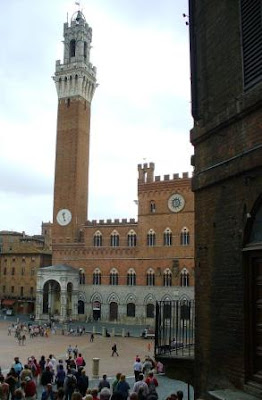
Siena’s main square, which is really fan-shaped, the Piazza del Campo, location of the famous biannual horse race, (some call it a folk festival) Il Palio, was spectacular. (For a more detailed description of what happens on race day click here.) The piazza is dominated by the Palazzo Pubblico and the Torre del Mangia (The clock tower). Interesting enough, the façade is curved inward (concave), following the curve of the piazza. The bell tower was the tallest structure in Italy upon its completion in 1344.

Siena's Palazzo Pubblico and the Torre del Mangia (the clock tower)

Siena's Palazzo Pubblico on the Piazza del Campo.

From the Piazza it is a short walk to the Siena Duomo. The cathedral, completed in 1263, was very impressive with its black, white and pink marble, but it was very dark on the inside. The cathedral floor is suppose to be one of the most ornate floors of all Italy’s churches, but most of it was covered to protect the delicate mosaics from more wear and tear. We were fortunate to see one of the oldest floor panels, the She-wolf of Siena. Although the cathedral contains many artistic treasures from Michelangelo, Donatello, Bernini, and others, it was the Piccolomini Library that I found most impressive. The painted frescoes tell the story of Siena’s favorite son, Cardinal Enea Piccolomini who would later become Pope Pius II from 1458 – 1464.

Siena's Duomo facade.

Inside the Siena Duomo. Strickingly, and different than any other cathedral we saw, the black and white horisontal marble effect. This picture was "doctored" to lighten it a bit. It was quite dark inside the Duomo.

Unfortunately we never had a lot of time to explore the medieval city center because of the rain. We had lunch at a grotto-like ristorante, called Cannonero, where the bread was rock-hard, the zuppa fantastic, the spaghetti tasteless, but the Chianti Classico marvelous. We shared a table with two French couples and one of the men degraded the lovely wine by drinking it with water. Luckily his wife had more sense and enjoyed it as is.

The highlight of the day was a stop at San Gimignano on our way back to Florence. The historic center of the town is a UNESCO World Heritage site. It served as an important relay point for travellers to or from Rome on the Via Francigena. At one stage the town had 72 tower-houses, built by families to show their power and wealth, but only 14 survive.

San Gimignano's main street. In the back is the arched entrance to the medieval city. There are no sidewalks in the town. The few cars and pedestrians share the modern paved roads. San Gimignano is probably the most famous small in Italy and it is obvious that the town council knows that it has a "tourist goldmine" as its hands, hence the fact that the town is in an excellent maintained state. It has many good restaurants, art galleries and shops that sells locally produced artifacts.

We only had an hour to explore the town and rain threatened all the time. Walking around in this 12th century medieval town with its many towers was beyond words. The narrow streets, barely 2 meters wide at some places, and some pitch dark, grotto-like, gives one some idea what life was like in the middle ages. The small town with a single main road between two squares was one non-stop tourist trap, shop after shop, selling “local craftwork”, probably made somewhere else in Italy. I ventured of the main road to take some pictures of other parts of the town, eventually ending up at an old castle, while Monica and Lamar toured the main road. In the end I ran out of time and luck. I had to run back to the bus in pouring rain, but I made it, just in time before the bus departed. But San Gimignano was well worth it, a marvelous town, just wished we had more time.

Three of the remaining 14 towers seen from the hilltop castle.

Upon our return to Florence I bought some pasta, meat and ingredients to make Penne al Ragu-Bolognaise. We are still to eat a good meal in Italy and my family agrees that I make a good Ragu, better than what we had in Italy so far. Apart from the pizza the first night in Naples, which was the best pizza I had in my life, the food has been rather average to poor.

Siena Duomo floor panel. This panel, the She-Wolf of Siena, was one of only a very few that were not covered for protection. This panel was create around 1372. Imagine how many few have walked across this mosaic the past 635 years. No wonder they cover them protection.

Unlike other churches where you have to look up and wonder at the details of the rose window, the Sienese removed the original rose window and it is now displayed in the Duomo's choir. This 6 x 6 meter window tells the story of the Last Supper.

The vivid colors of these frescoes, painted between 1502 and 1507 by Pinturicchio and his assistants, in the Piccolomini Library makes them a jewel on the eye.


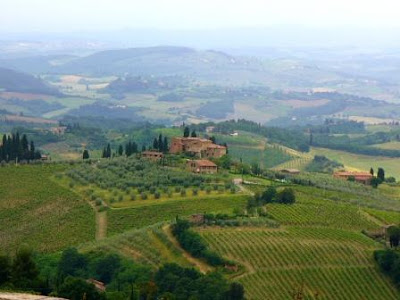
Tuscan countryside: A farm under grapes and olive groves.

Monica in San Gimignano.

Andre & Lamar in San Gimignano in our hastily purchased "Italia" sweaters.