Showing posts with label Food and Wine. Show all posts

Sunday, December 18, 2016

Ikarian French Fusion – A Vegetable Casserole


It was the end of summer and fresh vegetables were in season. Zucchini, yellow squash, eggplants, tomatoes, etc., and all the necessary herbs were freely available from the garden or the greengrocer, and at good prices too. So if you have it all, and more, in the pantry or fridge what better way to celebrate that magical culinary explosion of tastes with a French Provencal classic, a ratatouille?

But wait! The French are not the only ones that have learned to lift a simple vegetable stew to extraordinary culinary heights. More than 2,800 kilometers southeast of Provence there is a small island where people forget to die.

Ikaria, also spelled Icaria, is a small Greek island in the northeastern Aegean Sea, about 30 miles from the coast of Turkey and about 2 hours by ferry east of Mykonos. Ikaria is one of the identified “Blue Zones” in the world, a demographic and/or geographic area where people live, on average, to a very old age due to the food they eat, the lifestyle they live, the amount of physical activity they are involved in and their engaging relationships with family and lifelong friends. The Blue Zones also have other characteristics: the people rarely move out of the area and they exhibit a rigid pattern of similar activities in their community. In Blue Zones it is not unusual for people in their late 80s or 90s to still attend to their vegetable gardens, be beekeepers, or walk several miles a day. On Ikaria between 35%-40% of the islanders live to enjoy life into their 90s. In America, only 4.7% of the current population reaches their 90s. That's why they call Ikaria the island where people forget to die.

A pan of roasted vegetables

I love veggies in general, roasted or as a stew. Whether it is a South African green beans, onions, tomatoes and potatoes stew, a Southwestern corn and black beans stew, Grecian Spanakopita (Spinach and feta cheese pies), or a simple pan of roasted mixed vegetables with fresh Italian herbs and olive oil. In the past ratatouille, that classic French vegetable stew has been my go to dish. It goes well with any kind of protein or grain dish. It gives contrasting flavor and texture to fish dishes, stands up perfectly to grilled steaks or lamb chops and compliments any chicken or pork roast. Of course, ratatouille is very similar in ingredients and in method of preparation as the Grecian Briami, another classic vegetable stew.

A few months ago I watched an international food program on television about Ikaria and one of the dishes featured was the famous “longevity” Ikarian vegetable stew. Where the French prepare the individual vegetables for a ratatouille separately and then combine it all into a single pot and stew it on the stove until it forms a rich sauce, the Ikarians prepare the long cooking vegetables like beans or peas in advance of the other vegetables and then combine it all into a casserole to be baked in the oven. The fact that more or less the same ingredients and herbs can be taken, and produce two totally different flavor sensations and textures, simply because of a slight variance in preparation methods, makes cooking such an interesting hobby. Since then I have had a healthy interest in Greek and Ikarian food. Especially the way they prepare their vegetables.
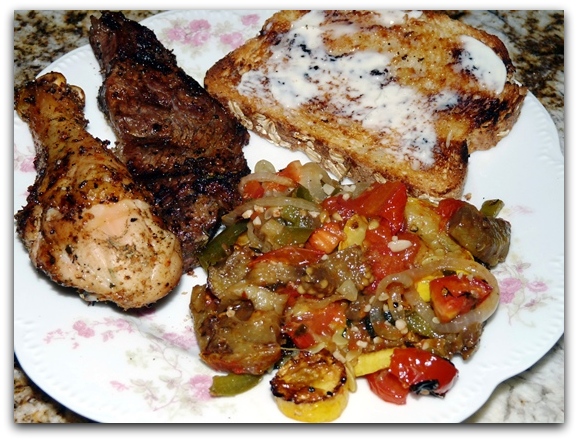

A Sunday afternoon. A month or so ago. It rained nearly constantly for 24 hours and the clouds have cleared up nicely by the afternoon, but left behind a wet and humid world. By early evening the humidity disappeared and I was going to barbeque a rib-eye steak, some chicken drumsticks and grill a few slices of wheat and oat bread using the vegetables as a bruschetta. Accompanied the food and in keeping it all Mediterranean, a bottle of Marqués de Cáceres Rioja Crianza 2011 from Spain.
  

In the past I have made Ikarian vegetable stews using black eyed peas or butter beans as a base for the casserole and then followed with traditional veggies like carrots, onions and tomatoes. In an effort to be innovative I decided to create an Ikarian French fusion. I used the basic ingredients for a ratatouille, but followed the Ikarian method of preparation. It is very similar to the Greek Soufica dish that uses eggplant as a base.

 
The result: A hot vegetable salad. Yes, this was not a stew at all. It was summer goodness at its best. An explosion of bright, summer colors, fused sweetness from the various ingredients and melded textures, but one could still taste every ingredient individually. It was so unlike the richness and sauciness of a ratatouille, which is more robust and leans itself more to winter comfort food.

A forkful of summer delight
 
And it’s really simple, rustic and as Jamie Oliver would say, naked.

Ingredients

·         Skin one eggplant, cut in ¼ inch slices, salt on both sides and let it sweat in a colander for at least an hour
·         In the meantime slice 1 zucchini and 1 yellow squash into ¼ inch thickness (same as the eggplant for even cooking)
·         Slice 1 Spanish or yellow onion into thin slices, put in a bowl and pour about a ¼ cup of olive oil over the onions and massage the oil into the onions with your fingers. (Yeah, get those fingers greasy.)
·         1 Green bell pepper, remove seeds and roughly chop into 1 inch pieces
·         4 cloves of garlic, peeled and mashed.
·         3-4 Roma tomatoes, chopped
·         Fresh Rosemary, oregano, basil and lots of thyme. Any combination will do.
·         Salt and pepper
·         Olive oil for grilling and frying

Preparation

·         Prepare a grill. Must be between 400 ºF and 450 ºF. You can also do this in the oven, but I prefer the grill.
·         Rinse the eggplant under water and dry with kitchen towels
·         Brush eggplant pieces lightly with olive oil (do not add any salt) and grill the eggplant for about 4 minutes on each side. You must get nice grill marks and the eggplant must feel soft to the touch, but still firm. Set aside
·         Heat the oven to 375 ºF
·         Heat a little oil in a skillet on the stove
·         Flavor the zucchini and the yellow squash lightly with salt and pepper and fry them until they get a golden color on both sides
·         Now layer the casserole
·         Put the eggplant at the bottom of a casserole dish and then add the zucchini, the squash, the green bell peppers, the onions and lastly the tomatoes
·         Add the herbs on top. No need to chop them.
·         Cover and bake for about 45 minutes. Remove cover and continue to bake for another 15 minutes.

Savor and enjoy!!!


Tuesday, August 23, 2016

Sielskos en Theuns Jordaan in 'n Perdeskuur


Daar het dié week so ‘n klein stormpie in die Afrikaanse musiekbedryf se koppie boeretroos uit gebreek. Gert Vlok Nel, skrywer, digter, sanger, en ‘n diep seun van die Afrikaanse taal, het die sanger Theuns Jordaan daarvan beskuldig dat laasgenoemde glo sy liedjie Beautiful in Beaufort-Wes, 18 jaar gelede gesteel het en slegs skamelike tantieme van ongeveer R8,000 aan Vlok oor betaal het. Ai toggie! En dit terwyl Nel gekrepeer het van armoede in die Karoo en Jordaan meer as 500,000 eksemplare van die liedjie verkoop het.

Ek persoonlik het natuurlik geen haan in dié geveg nie. Tewens, ek het nog nooit voor vandag na die liedjie Beautiful in Beaufort-Wes geluister nie. Na ek die storie gelees het het ek na albie se weergawe van die liedjie gaan luister op Youtube en ek kan eerlik nie verstaan waaroor die bohaai gaan nie. Nog minder kon ek verstaan hoe op dees aarde Jordaan 500,000 eksemplare kon verkoop gekry het, each to its own I guess. Maar volgens my kennis van die musiekbedryf is dit nie die sanger wat ‘n ander sanger se musiek opneem se plig om tantieme oor te betaal nie, maar die oorsponklike musiek uitgewer se plig. Dit werk so wêreld wyd. En hoekom die musiek bedryf anders werk as die boek bedryf waar skriftelike toestemming verkry moet word van die skrywer om sy or haar werk te gebruik, dit kan ek ook nie verduidelik nie. So Gert Vlok Nel sal maar aan ‘n ander deur moet gaan aanklop om sy tantieme te herwin. Good Luck! Onthou wat gebeur het met Sixto Rodriguez.

 
Vanoggend, terwyl rëenbui na rëenbui oor Kentucky uitgesak het, ek die storie op Maroela Media raakgelees het en ek ‘n ongewone Saterdag “vry” het op die plaas, het die geskarrel in die Afrikaanse musiekskuur my laat heriner aan ‘n Saterdagaand so amper ‘n jaar gelede toe ek en M en ‘n klomp ander Suid-Afrikaners opgetrek het Shelbyville toe om na ‘n konsert van Theuns Jordaan te gaan kyk in ‘n perdeskuur. Hy was deur ‘n Suid-Afrikaner wat nou hier in Kentucky boer uitgenooi om te kom op tree op ‘n perdeplaas met die gepaste naam van Singing Hills Farm, natuurlik sonder enige bedoelde woord speling. Voor die konsert het ek geen idee gehad wie Theuns Jordaan is nie en ek en M moes eers na van sy musiek gaan luister het. Ons was nou nie juis bowled over nie maar ‘n saamtrek is ‘n saamtrek. Hy kon wel daardie aand Beautiful in Beaufort-Wes gesing het, ek het geen idee nie.


Ek sê “’n vry Saterdag” want die afgelope twee maande met elke vrye oomblik is ek, M en my seun al besig om die plaashuis se sederhout huisbedekking te “power wash’, af te skuur, te sandpapier en te verf  terwyl dit die warmste, natste, bedompigste en mees insekte-besmette somer is die afgelope 18 jaar in Kentucky. En enige iemand wat al hul huis buite om geverf het sal weet wat se enorme taak dit is. So ‘n reëntjie op ‘n Saterdag is eintlik ‘n verwelkoming. Ongelukkig was daar ander werk wat ek toe gaan gedoen het in die werkswinkel. Daar is nooit regtig iets soos ‘n vry Saterdag nie.

En die ongure weersomstandighede gedurende die somer het ook veroorsaak dat die groentetuin maar ‘n skrale oes voort gebring het. Vorige jare het ons altyd ‘n oorvloed van groenboontjies en tamaties gehad wat ingelê kon word vir kerrieboontjies en pastasous, maar vanjaar is daar te min. Dit wat geoes kon word moes dadelik gebruik word in ‘n dis. So terwyl ek op die agterstoep sit en ‘n koppie boeretroos drink en die rëen beloer met droewige oë, dink ek wat ek sal maak met die emmertjie tamaties wat ek twee dae gelede geoes het. Daar is eitlik maar net een oplossing. Iets wat ek al weke voor lus is. Tamatiebredie! Wat is dan nou lekkerder as skaapskenkel en tamatiebredie. Ek besef skaapnek is seker ‘n beter snit maar om skaapnek in ons geweste by ‘n kruidenierwinkel te kry is soos om vir kudobiltong in Amerika te soek. En die skaap wat ek laas geslag het, net soos alle ander skape, het ongelukkig net een nek gehad en dit is al lank gelede in ‘n Franse bredie verorber. 

 
Ek weet dit is nie winter in Kentucky nie, maar die bewolkte, renerige weer het my laat voel ek is genoop om ‘n bredie te maak. En wie het die reël neer gelê om te sê bredies is net winterkos? Sielskos bly sielskos, winter of somer.  Tamatiebredie is een van die egte tradisies wat Suid-Afrikaners van die Hollanders geerf het. Dit is so tradisioneel Suid-Afrikaans soos braaivleis, biltong, malva pudding en Hertzog koekies. By sommige mense is daar die persepsie dat die Maleiers bredies na Suid-Afrika gebring het, maar dit is eintlik ‘n dis wat seker in die Midde Ooste by die oer-oue mense ontstaan het en toe weswaarts na Europa gereis het. Ek is seker die Franse Hugenote het ook hulle stempel op sekere Suid-Afrikaanse bredies geplaas, maar die Hollanders en later die trekboere en hul swart driebeenpotjies het die grondslag gelê om bredies ‘n lekkerbekkig en ‘n kulturele erfstuk van te maak. Dis seker hoekom swaarboompotte, swart gegote yster vir die vuur of gekleurde Chasseur vir die stoof of oond vandag nog bekend staan as “Dutch ovens”.

 
En om bygaande impak te voeg by die gemoedstoestand van tradisionele Suid-Afrikaanse kookkuns het ek my kelder besoek en ‘n bottel Groot Constantia 2008 Cabernet Sauvignon gaan uitkies. Wat kan nou meer tradisioneel wees as voggies van die oudste wynplaas in Suid-Afrika, die een wat die grondslag gelê het vir wynbou in die land. Ek het die bottel gekoop tydens ons laaste besoek aan Suid-Afrika in 2010 en dit gehou vir ‘n spesiale geleentheid en sienende dat my swaer Godfrey vandag sy 50ste verjaarsdag daar in die Suidelike Halfrond vier, is dit ‘n ideale geleentheid om dié bottel Groot Constantia van sy opgekurkte aromas en smake te verlig.

 
Sielskos!
Kaapse Tamatiebredie saam met Kaapse rooiwyn! Altyd ‘n uitstekende kombinasie!

Nou sit ek hier na aandete en in die woorde van daardie Worcester boytjie met die rooi veldskoene, David Kramer, “stoksiel alleen op ‘n Saterdagaand” maar gelukkig saam met M, op die agterstoep en sip aan my eie tuisgemaakte koppie Italiaanse cappuccino. Die tamatiebredie het fantasties uitgekom en die wyn was topgehalte. Definitief die hoë prys werd. Die storm in die Afrikaans musiekbedryf is vergete. Dit reen nog steeds en meer word voorspel vir die res van die nag. Maar die oomblik om te waardeer is nou. Die lewe is eenvoudig te kort vir margarine, geproseseerde kaas, TV dinners, Budweiser Light en goedkoop rooiwyn. 

PS: Ek sien nog 'n Afrikaanse troebadoer, Valiant Swart, is ook aan die kla oor booking agents en venue-eienaars wat maar traag is om te betaal wanneer hulle moet. Ek skat daar is ietsie wat stink en vrot is in die Afrikaanse musiekbedryf. 

Thursday, July 28, 2016

Provence, France Revisited


It is already quite something to find a bottle of Châteauneuf-du-Pape in a Kentucky liquor store, but then to find one of the vintage from the same year that I actually walked through that specific Château’s vineyard is really magic. Pure nostalgic value! What a coincidence! Of course, if you live in a wine region then this kind of thing can happen quite often, but not when you live a continent away and a visit to France is a rare occurrence.

The Discovery

But that is exactly what happened a few weeks ago when I wandered through a local liquor store’s aisles and stumbled upon three lone bottles of 2012 Château Mont-Redon. They were standing on the edge of the French section, alone by themselves with no indication of price. I thought I had to relieve them from their loneliness. I saw the store manager nearby and asked him to check the price, expecting to hear something close to or above $40, the usual price for an average Châteauneuf-du-Pape. After a few minutes of trying to find the wine in their computer system, he said that the wine was supposed to be sold out and there is no price in the system. So I gave him the eyes and said “Well, obviously it’s not.” He then asked me where I found it and I said “It was standing near other bottles priced at $16.” I did notice that they were in the process of reorganizing the store.

Then he gave me the eyes. He was deep in thought for a few seconds, looked at the bottle again and then smiled wryly, and said, “Ok, you found it. $16.” I thanked him, took the bottle, quickly walked away before he could have second thoughts and then went to collect the other 2 bottles too. Returning home I search the internet and saw that wine.com is selling it for $42 a bottle. What a bargain!

 
What’s for Dinner?

So come Sunday, M took out a frozen packet of ribs for barbequing, thinking it was pork ribs, but instead it was beef short ribs. Which, off course, can also be grilled successfully if you like your beef tender and still half bloody on the inside, but my family does not like their steaks that way. In any case, that Sunday by 1:00 pm it was 95 degrees Fahrenheit in the shade, the humidity in the 90s, meaning the heat index could have been well over a 100 degrees, and we fled inside to the cool of the air-conditioned house. There was no way I was going to stand in front of a hot grill in that heat. So it became another experimental Sunday afternoon in the kitchen.

I was not in the mood for a boeuf bourguignon; I made that a few weeks ago to accompany a bottle of Allesverloren Shiraz that M bought me some time ago. So I stuck my nose into Jacques Pépin’s near 700 page culinary bible, Essential Pepin, to see if I can find a Provençal classic to bring the best out of its Châteauneuf-du-Pape neighbor. And on page 323 I found something that looked interesting and which I could adapt to put my own stamp on, a Boeuf Daube Arlésienne, a beef stew that comes from the Provençal town of Arles.


Starry Starry Night

Arles, located on the banks of the Rhone River, and the surrounding area have been populated for the past 2,800 years by various civilizations, among other the Ligurians from northern Italy, the Celts, the Phoenicians, the Romans, the Moors from Spain, and eventually in 1378 it became part of the kingdom of France. During the late Roman era, the 4th and 5th Century AD, the town was very popular with Roman Emperors that used it as their headquarters during military campaigns in the region. The town still boasts several Roman ruins and buildings, including the magnificent colosseum-like amphitheater. But the town is probably more famous today for the 200-odd paintings that Vincent Van Gogh painted here during his 14 month stay in 1888 and 1889. The Night Cafe, the Yellow Room, Starry Night over the Rhone, L'Arlésienne and of course, Café Terrace at Night, is among the famous paintings Van Gogh painted here.

Vincent van Gogh's Café Terrace at Night in Arles

 
Another connection and point of nostalgia; During our 2012 visit to Provence we did not ventured as far south as Arles. Our furthest point south was Les Baux-de-Provence and Saint-Rémy-de-Provence, where we visited the Saint-Paul Asylum. Van Gogh came to Saint-Rémy after his Arles period and spent a year in the asylum from May 1889 to May 1890. During his Saint-Rémy stay he painted many canvasses of the hospital’s garden, the surrounding fields and the famous The Starry Night and Irises. Two months after Van Gogh left Saint-Remy he shot himself and died in the town of Auvers-sur-Oise, north of Paris.  

Starry Night.
Painted by Van Gogh while staying in Saint-Paul Asylum in Saint-Remy-de-Provence

Of course, we also visited the tiny enclave of Châteauneuf-du-Pape (see my blogs here and here about our visit.) Although we never went for a tasting at Château Mont-Redon, we had lunch just up the hill from the estate, but after lunch our guide stopped at the domaine to give us a short history about the area and to tell us about the importance of the river stones that are the “secret” to the wonderful wines made in this valley. And we went for a walk through the vineyards.

Taking a walk through the vineyard of Château Mont-Redon

Perusing the recipe I realized I had all the ingredients required for a Boeuf Daube Arlésienne, but I decided to replace the white wine the recipe asked for with red wine, making it a little heavier dish than the original. A few days earlier I opened a local Kentucky merlot, but after a few sips I destined it to be more suited for the pot than for my palate.  The merlot now came in handy. In order not to change the recipe into a bourguignon one has to have a light hand with the red wine. I was maybe a little too heavy handed because I marinated the short ribs in the merlot, some garlic and dried Herbes de Provence for about two hours. That in itself made it lean towards a bourguignon. Nevertheless, I am not going to publish my recipe because I am sure my daube did not taste at all like that of Pepin’s and the method I used was also much different than his. So it will be a gross injustice to Mr. Pepin to publish my adaptation or his recipe, because mine, I am in no doubt, was a far flung deviation from his.


I tested a piece of the short rib after browning it in the pot and it was melt-in-the-mouth tender.

 
It’s All About The Terroir

I have to admit I was in two minds about opening a bottle of Mont-Redon. It was only 4 years old, relatively young for a Châteauneuf-du-Pape red, but I was also charmed by its possibilities and by what it could offer at this tender age. I have learned over the years that modern wines could be surprising good at a young age and sometimes terrible at an older age. In the end my inquisitiveness and sentiment got the upper hand.  


The Château Mont-Redon.
In the family picture of the current owners, top left: Didier Fabre (front left), Yan Abeille, Jerome Abeille, Pierre Fabre and Jean Abeille (front right)

 
Wine has been produced on the Mont-Redon estate since the age of the Avignon Popes and the estate was first mentioned in historic documents from 1344 as “Mourredon’. Between then and the 1700s not much is known about the property until Joseph d’Astier, a lawyer from Avignon, obtained the property. His descendants, the Mathieu family owned the estate until about 1856 when, at the death of Clara Mathieu, the property was divided between her children. Shortly thereafter the phylloxera epidemic of the 1880s devastated wine-making at the estate and in most of the winemaking regions of the world. In 1923 when Henri Plantin obtained the property, Mont-Redon consisted of only 2.5 hectares of scattered vineyards. Plantin and his descendants actively worked to enlarge the estate, buying up adjacent land when it became available and today it consists of 186 hectares with 100 hectares under vineyard,  making it the largest single-vineyard estate in the Châteauneuf-du-Pape valley and one of the most well-known and respected producers of crus in the appellation.  The current owners, Jean Abeille and Didier Fabre, the 3rd generation descendants from Plantin, have also expanded their operations beyond the valley and now also produce Côtes-du-Rhône wines from 35 hectares they own across the Rhône River. 

 
In the glass the wine was a deep ruby red and still very purple at the rim. On the nose it was fruity with faint hints of chocolate and characteristically from a Châteauneuf-du-Pape wine, strong hints of licorice. But the proof is always in the pudding, and on the palate the initial taste had surprisingly strong tannins, with cherries and blackberries and the licorice was now shining through as if to confirm its terroir. The ending was rather abrupt and mildly spicy.

I thought I made a big mistake to open the bottle so soon with the tannins still grossly underdeveloped. So I let the wine rest while I continued with the Boeuf Daube Arlésienne, which by this time looked more like a bourguignon. In hindsight the Burgundian version was better suited for the wine in any case and I am sure there is a Provençal dish out there with red wine very similar to its northern cousin.

 
Finishing off a Mediterranean ensemble

An hour later to finish off the dish and to give it a more distinctive Mediterranean twist I added some Greek capers, Spanish Manzanilla olives, but to counter the vinegary taste of the olives and saltiness of the capers I added a teaspoon of “treasure” from our pantry to add sweetness, Confit d’Olive, all the way from Blaauwklippen Road in Stellenbosch, South Africa. The confit or mountain marmalade has a very unique flavor, and until I found it in a store in Lexington, KY, of all places, I would not have thought one could make jam from black olives. BTW, it goes very well with camembert or brie cheese on crackers.

The rest and the air did the wine a world of good. Although the tannins were still distinct, clinging to the tongue, it has mellowed a bit. The middle became soft and rounder and the aftertaste longer and a little spicier with a stronger hint of chocolate. (Oops! That sounds like I am describing a maturing woman. But don’t they always say a woman is like a good wine that gets better with time?)

The wine, made mainly from the Grenache, Shiraz, and Mourvèdre cultivars and topped up with Cinsault, Cournoise, Muscardin, and Varrarèse, was, to use a Kentucky term, a thoroughbred Châteauneuf-du-Pape. Overall the wine was a very good, fully bodied, well-balanced wine, a true grand cru that can only get better with age. It went very well with the food, which in the end turned out to be a classic I-like-to-cook-with-wine-and-sometimes-even-put-it-in-the-food experiment. How long the other two bottles will last time will tell.

What a bargain for $16?


My apologies Mr. Pépin, but in my hands your boeuf daube Arlésienne, turned out to be more of a Mediterranean-influenced boeuf bourguignon.

 The chef at work in the kitchen. 

Tuesday, September 8, 2015

Savoring Regional Delicacies in Monterrey, Mexico


The nebulous sky at twilight, thick with Monterrey’s ever present white dust and yellow smog, glowed orangey as I left the hotel on my first night here to walk to a new restaurant nearby. Although there was no humidity in the air and the last of the day’s oppressive heat was dissipating, the heat still felt sticky on my skin.

Los Fresnos Bar and Grill, squeezed in between the Hampton Inn and the Marriott Courtyard on your way to the aéroport is a man’s world, or so it seemed. Most the waiters are older gentlemen, some I have to guess in their late 50’s or early 60’s. The role of women is strictly reduced to cleaning.
 
Even the recepcionista, usual a lady in Mexican restaurants was a male.  The décor also contributed to the sense of machoism with stuffed deer and goats on the walls (Cecil the lion would have felt at ease here after his demised by that American dentist) and American football on the TVs at the bar, but I am not for one minute bashing the culture of Nuevo Léon. This part of Mexico, just south of Texas, is after all ranchero country where "real" men wear ten gallon hats, expensive cowboy boots and is judged by how big and silvery his belt bucket is. Only the strong survive here.  

Initially I thought fresnos, which means "ashes" in English, refers to dead embers since most of the menu’s dishes are prepared on the grill. But upon my asking the waiter told me it refers to the many ash trees one finds in this region. That immediately made me felt at home since I have tens if not more than a hundred ash tree on Lily Rose Ranch. 

The menu was regional. Whenever you see cabrito on a menu you know you are in Monterrey. A cabrito is a kid goat that is less than 3 months old and still a suckling, thus, before it starts to eat solid foods. In Monterrey, cabrito dates back to the founding days of the city and some of its Jewish settlers. Prepared al pastor is the way they do it here. The whole carcass is opened flat and impaled on a spit. The spit is then placed next to a bed of glowing embers and roasted slowly without any spices and turned often. I have eaten it on several occasions because it is very tender but I always missed the traditional dry rub spices of South African or American grilled meat.

But I didn’t ordered cabrito on my first night. I saw something very rare and unusual on a Monterrey restaurant menu. Lamb! Nuevo Léon is more cattle and goat country. Although I have tried to discover which kind of cut it is they offered, the waiter was either purposefully vague or he simply did not understood my questions.

Loin chops? I asked. Si, he said.
Leg? I asked, Si, he said.
He eventually sighed and said, plato, plateful.

I guessed that meant you could get anything, even some cuts you would not generally expect on your plate. I decided to order blindly. What the heck, in this region were grilled meat was the equivalent of Le Gigot d'Agneau a la Francaise I could not expected gourmet food from a non-Michelin star restaurant and the chef in the kitchen behind a glass partitioning was most certainly not Gordon Ramsey either.

 
With my meal I ordered a bottle of locally produced vino tinto, a Vinos Demecq XA Cabernet Sauvignon from Baja California. Not too bad, lots of tannins, thus a bit dry, definitely full bodied in the usual Mexican style and without the pretentious or artificially enhanced subtle hints or, in some cases strong suggestions, of chocolate and coffee and over ripened fruits that are so prevalent these days from American cabernet producers. Although not the best in class by any stretch of the imagination, it was classic, old time cabernet. Robust and full-bodied.  

Well, I got what I sort of expected. Lamb-all-sorts with a few potato fries and vegetables. A leg chop, rib meat, a bit of loin, more rib meat and even a kidney still surrounded by its fatty protection. And it was a plateful alright. All in all, it was not bad though, a bit too fatty for my taste and it lacked spices. But there was enough red and green chili salsa on the table to compensate for the lack of spices.

 
Dessert was Flan (what else?), the quintessential Mexican dessert. The age old dish was invented by the Romans as a savory cake topped by peppers. It sounds like it was more a quiche than a flan in its infant days. As the recipe moved westwards with the Romans to the Iberian Peninsula the dish was adapted and became sweeter and the Spanish began to top theirs with a caramel sauce. The conquering conquistadors of the 16th and 17th Centuries carried it across the Atlantic with them to the Caribbean and Latin America and so it reached Mexico, where the Mexicans took the simple custard pie to new heights in the kitchens of the rich and poor alike.   

On that night I chose Flan Napolitano with a thick caramel sauce topped by nuts.

Upon leaving Los Fresnos, Pedro, the waiter, who must have been in his sixties, and who all night long was so careful to pour my cabernet just the right way, complete with cotton napkin around the neck of the bottle to prevent any spilling, came over a last time to shake my hand as if we were old friends that got together for a long overdue evening of drinks, good food and even better company. He was very surprised and gave me a broad smile when I shook his hand in the local Nuevo Léon way, four fingers around the thumb instead of the usual western way. That really sealed the newly formed friendship that will probably last no longer than this single visit to Los Fresnos.

 
However, I returned to Los Fresnos on two additional occasions over the 10 day period I was in Mexico to also savor other regional dishes like the pescado Vera Cruz, tilapia fish in a mild tomato, onion and sweet pepper sauce served on Mexican rice, and especially the “Death on two legs” as I like to call it, (in honor of the Freddie Mercury and Queen song), Camerones Brochette, cheese-stuffed bacon-wrapped shrimps. I have eaten this dish on many occasions in Monterrey over the past 10 years of coming here and have always gone back to it because it is sooooo good. Los Fresnos’s version was a bit dry (shrimps was too small, I presume) and not as good as I have tasted before, especially at Mariscos La Anacua on Tauro Street in San Nicolas de los Garza, a real hole in the wall, frequented almost exclusively by locals for its cheap, no frills, but excellent seafood and Mexican beer by the liter.

 
Later, while I sat in my hotel room to write this, a sing-along to the accordion tunes of Mexican country music drifted through the open balcony door from the garden below. Since early evening a large group of people were barbequing downstairs and I guess the beer that flowed so freely has loosened the vocal cords and their inhibitions.  

If I can make any suggestions, I would say they shouldn’t give up their day jobs, at least not yet…

 
Adios! Monterrey.
 

Wednesday, August 13, 2014

‘n Kaaps-Italiaanse Gemoedstoestand - Penne met Boerewors, Pinotage en Basiliekruid


Dis nou al weke dat ek lus is vir boerewors. So uit die bloute uit. Sedert ek laas in 2010 in Suid-Afrika was het ek boerewors geëet, maar dis so lank gelede ek kan nie eens meer onthou wanneer laas nie. Dit moet jare wees. Ek skat 2011 laas. Ek het nou selfs so ver gegaan en geprobeer om boerewors speserye oor die Internet gekoop by African Hut in California en Out of Africa Trading in Vancouver, maar beide het nie Freddy Hirsch se Grabouw Boerewors speserye in voorraad gehad nie. Die goed moet gewild wees. Terloops, wat ‘n verrassing was dit nie toe ek ontdek het dat Grabouw boerewors speserye en vele ander nou beskikbaar is op die Internet. Ek wag nou vir die volgende aflewering daarvan by African Hut.
  
Hoekom dan net Grabouw speserye? Dis waaraan ek gewoond was, mee opgegroei het en waarna ek nou smag. Die perfekte balans tussen vleis, vet, koljander, neutmuskaat en naeltjies. Ek sê nie dis die beste boerewors nie; die “beste” bestaan net in elke fynproewer se palaat. Boerewors is mos ‘n tradisionele lekkerny en soos dit maar is met elke land se eie tradisionele geregte, is daar soveel “die beste” soos elkeen se eie resep of die resep waarmee hy/sy grootgeword het.

 
Toe ek laas in Suid-Afrika was het ek spesiaal ‘n ompad gery om by Grabouw te stop en wors speserye te koop. Ek het voorheen hieroor geskryf in 2011. Ek het destyds met die terugkoms boerewors te maak en die speserye gebruik, maar myne was glad nie so ‘n sukses soos die ware Jakob wat ek in Suid-Afrika geëet het nie.

Laas Vrydag moes ek in Lexington, KY, wees en toe maar my moed laat begewe en by Critchfield Meats gaan stop en ‘n pak “Karpse Boerewors”, soos die etiket gelees het, gekoop. Jare gelede het ek al besluit Critchfield Meats mag dalk hul boerewors boerewors noem, maar dit was nog altyd net so ‘n verre smaak afwyking soos die verkragting van die woord “Kaapse” op hul etikette. Ek het doerie tyd al besluit om nie meer van hul boerewors te koop nie. Nie dat my probeerslae enigsins beter is nie! Maar dis sooibrandpillewors. Want die geëet van hulle weergawe van boerewors en sooibrand loop hand-aan-hand soos lovers op ‘n evening stroll na ete. Gewoonlik het hulle wors te veel asyn en te min koljander in.    


Maar dit was nogtans met afwagting dat ek Saterdagaand die helfte van die pak wors saam met ‘n skaaptjoppie of twee op die kole gegooi het. Soos altyd het ek ekstra koljander fyngemaal en bo-op die wors  geskrooi voor braaityd. Maar groot was my teleurstelling, wat het ek regtig verwag, maar ook verbasing om ‘n soetigheid in die wors te proe in plaas van die gewone suurigheid van “te veel asyn.” Nou nie cheesecake soet nie, maar ‘n duidelike suggestie van ietsie soet. Het die slagter nou gaan staan en bruinsuiker by die wors gooi? Ek weet van sekere, rare boerewors resepte wat vra vir bruinsuiker, (‘n onding na my mening) maar net ‘n titsel om van die asyn te neutraliseer. ‘n Mens is nooit veronderstel om dit te proe nie. Of as ‘n mens Karoo Boerewors maak en brandewyn gebruik het ek al gesien die resep vra vir ‘n bietjie soetwyn. Miskien het die slagter se suikerhand geglip? Of…hy kon tog nie perdevleis gebruik het nie. Hulle sê mos dit het so ‘n soeterige smaak en Kentucky is mos perde wêreld. No, no…no benefit of the doubt! Hulle wors was nog altyd en bly kak.

Maar wat gemaak met die ander helfte van die gekoopte pak wors?  Kom Sondagaand en ek wou eers ‘n Lancashire Sausage Hotpot maak met gekapte aartapels en jong wortels op ‘n uie, knoffel en bietjie tamatie fondasie, maar hoe meer ek dink aan die soetigheid hoe meer het ek geneig na ‘n tamatie pasta sous. Die soetigheid gaan mos beter saamsmelt met die delikate soetigheid van ‘n goeie tamatiesous. Dit laat my mos ook ruimte om die smaak te beheer afhangende van hoe sterk die neutmuskaat en naeltjies smaak na vore gaan kom. Ek besluit toe maar om innoverend te wees en my eie resep te skep Penne con contadino salsiccia e vino rosso e basilico, Penne met Boerewors, rooiwyn en basiliekruid, te maak. Nie dat ‘n mens regtig boerewors kan vertaaal na farmer or peasant wors nie. Boerewors is boerewors! Maar dan weer, dié wors is ‘n kama-boerewors, so ‘n Italiaanse vertaling is aan die orde van die dag.   


Ek begin toe maar. Of as ek Esmé Euvrard en Jan Cronje mag aanhaal: Só maak mens…

Kap ‘n groot Spaanse geel ui, ‘n handvol jong worteltjies en 3 knoffelhuisies fyn. Intussen verhit ‘n bietjie olyfolie in ‘n pan, voeg die uie en wortels by en laat dit soteer vir 6 tot 8 minute. Die uie moet begin karameliseer. Voeg dan die knoffel by vir so ‘n minuut en skep dan alles uit en hou eenkant. Terwyl die uie en wortels elk hul sagter sy ontdek en mekaar beter leer ken deur die geprut, sny solank die wors op in 1 duim dwergworsies, happie grote.  Gooi die wors in die pan en braai liggies. Hoekom gooi ek nie net sommer die wors by die uie nie? Ek wou eers probeer agterkom hoe sterk die reuk van speserye en asyn na vore kom om te bepaal hoeveel en watter ander speserye en kruie ek moet byvoeg. Gewoonlik as gegeurde vleis begin opwarm, binne die eerste 2 of 3 minute, is die ontlading van die verskillende reuke van die speserye die sterkste. Dis toe dat ek sal agterkom wat die soetheid in die wors veroorsaak. Of wel ek dink so. Dit was die asyn. In plaas van ‘n tipiese suurige reuk van bruin asyn het ek ‘n soetige asyn reuk in die stoom vanaf die pan bespeur.


 Selfs 'n wildsbokkie het nader gestaan en kom kyk wat maak ek op die stoep.

Braai die worsies vir ‘n paar minute net tot alle kante begin vaal-bruin word. Voeg dan ‘n glas rooiwyn by, laat die alkohol verdamp, skep die uie-en-wortel mengsel terug in die pan en gooi ‘n 14 oz. bottel gekoopte tamatie pasta sous by. In my geval was dit ‘n bottel ingevoerde Gia Russa Marinara sous van Italië, maar enige goeie spaghetti-sous sal werk. Om so ‘n bietjie extra woema te gee het ek 1 teelepel gedroogte Siciliaanse kruie, 2 teelepels gedroogte Italiaanse kruie, sout en swartpeper by gevoeg.  Sit ‘n deksel op die pan en laat dit saggies stowe vir omtrent ‘n uur.

Sienende dat ek dan nou ‘n amperse Suid-Afrikaanse atmosfeer geskep het met die kama-boerewors en die reuke van ‘n Italiaanse plaaskombuis die huis deurweek, let’s go all the way, en ek maak toe maar ‘n bottel Bolandse voggies oop om ‘n volledige Kaaps-Italiaanse  gemoedstoestand daar te stel. Hoe dan anders? Pinotage is mos eg Suid-Afrikaans, gebore en getoë in Stellenbosch, en Nederburg is ‘n Kaapse ikoon soos Paarlberg se Taalmonument, net oor die bult vanaf die bekende wynmaker.      
 
So terwyl die boerewors sy unieke vleis en spesery geure laat uitsypel en saamsmelt met die roomerige tamatiesous, vat ek ‘n ruskansie in ‘n skommelstoel op die agterstoep, staar uit oor die weiveld, nog sonder skapies, geniet ‘n sigaret en sip aan die rooi voggies. Ek het ook ‘n draai gaan maak in die tuin en ‘n handvol basiliekruid blare en vine ripened tamaties gaan pluk.

Die wyn, 'n 2010 Nederburg Pinotage, Winemaker's Reserve, was 'n uitstekende voorbeeld van hoe 'n Pinotage moet proe en lyk. In die glas was dit diep robyn rooi met baie min purper op die rante en die neus was vol pruime en 'n bietjie eikehout. Op die palaat was dit 'n vet, sagte, mondvol vrugte sonder die kenmerkende aardse smaak wat in baie Suid-Afrikaanse wyne voorkom. Min tanniene te bespeur. Die nasmaak was lank, peperig met fluisterende gerugte van bitter swart koffie. In die algemeen 'n hoogs verfijnde wyn. Wilhelm Pienaar, die wynmaker het hom uitstekend van sy taak gekwyt.


Terug in die kombuis, kook so veel penne pasta soos benodig in soutwater tot al dente. Indien te veel van die tamatiesous weggekook is kan van die verrykte pastawater by die sous gevoeg word. Of nog  rooiwyn. Take no prisoners. Ek het van beide bygevoeg. Dreineer die pasta en voeg dit by die boerewors-en-tamatie mengsel, gooi driekwart van die gekapte basiliekruid by en meng liggies.


Now for the crowning glory. Strooi ‘n laag, so ‘n opgehoopte handvol, gesnipperde Mozzarella kaas, ‘n goeie laag gerasperde Parmigiano-Reggiano kaas en nog 'n handvol gesnipperde Cheddar kaas bo oor die kosmengsel, sit die deksel terug, sit die stoof af, en vat nog ‘n ruskansie op die stoep, neem 'n foto of twee van 'n wildsbok wat nuuskierig nader staan, terwyl die kaas smelt en hul romerigheid die pasta mengsel beseën en bevrug. Koskook is mos harde werk!  


Net voor opskeptyd strooi twee klein, gekapte tamaties en die laaste van die basiliekruid oor die kos as garneering.


M se kommentaar oor hierdie Boere-Italiaanse kooksel: OMG!!! Die gereg het 'n sagte robuuste smaak gehad vanwee die boerewors se skerp speserye en Siciliaanse kruie maar was tog ook romerig vanwee die topgehalte tamatiesous en handevol kaas. Definitely a keeper, as ek net boerewors in die hande kan kry.


Na 'n stukkie aarbeie kaaskoek vir nagereg het ek die naderende sonsondergang met 'n beker koffie vanaf die agterstoep gesit en besigtig. Hoogs tevrede met die resultaat van my Penne con contadino salsiccia e vino rosso e basilico, Penne met Boerewors, Pinotage rooiwyn en basiliekruid,