Showing posts with label Rome. Show all posts

Wednesday, July 30, 2008

More Vatican Treasures

Going through some pictures of our travels through Italy that I am trying to rescue from a archived CD I came across some that I have never used previously or have used in a different format, either as part of a heading or a collage. I thought they should shine in their own right. These were taken at Vatican City. You can also see more Vatican images by clicking here.

A quiet gallery off a busy walkway with marble horses and several other statues.

Perseus with the head of Madusa.


Delicate sculptures above an entrance door to a gallery.

Artimes with her many breasts. Indian inspired Greek art work.

A Bronze Herculus. Not many bronze artwork from the Roman or pre-Roman period survived the smelter's oven. There is another rare bronze of Herculus in the Capitoline Museums. (look out for it in another post soon.)

I am not sure about this piece, but I think it is Apollo.


A magnificent detailed frieze against one of the gallery walls.

Sunday, July 22, 2007

A Final Swing Through Rome

Very early on the second last day of our Italian vacation, at 5:30 AM, we took a vaporatto to St.Lucia stazione. Our visit to Venice was nearly over and another few hours to explore Rome were on the cards. But before that we first had to complete a four and a half hour train ride to there.

At our arrival in Rome we walked the short distance to the Hotel RomAntica, unpacked the necessary and then headed back to the Rome Termini to take the Red 110 bus for a two hour drive to look at Rome’s architecture from a different view, the top of an open bus. Sure the view was different and we saw a few places we missed the first time we were in Rome, but nothing special to really report. Upon our return Monica went for a walkabout to do last minute shopping.

Late the afternoon she and I went for a walk to visit the Santa Maria Maggiore church. It was one of the churches on my list that I wanted to see on our first visit, but time ran out and we never got to it. I was so glad we made time for it on our last sightseeing day in Italy. What a beauty! Make that with a capital B! St Peters was impressive with all its big name artists and sculptures and St. Mark’s basilica in Venice was beautiful with its incredible mosaics, but both felt cold. There were a lot of treasures but no feelings, no warmth. Santa Maria Maggiore was totally different. It was alive! There was warmth and spirit and it felt like a dignified place were people come to give something, say thank you, or just wanted to be at. The place was full of people that came to prayer, and a service was actually in progress when we arrived there, which limited our access to certain areas of the church, understandably so. No wonder so many popes decided to be buried in this church. Maybe they also felt the difference.

That evening a thunderstorm dampened our plan to take a last, open air terrace dinner under the Roman sky. We were forced indoors at the La Mense il Bucco ristorante, where we also had lunch earlier the day. The dinner (and the lunch) was simple, real Roman food, but excellent. One of the few good dinners we had in Italy. During our trip we seldom ate indoors, mostly under an umbrella on the sidewalk. I loved that, gives one time to do people watching and in Italy it just feels do natural to eat outdoors. Being indoors makes me feel separated from the experience of traveling.

The last morning was a whirl of activity to get to the train station and then to the airport. What was supposed to be a non-stopped train to the airport, the train stopped several times because of maintenance work on the tracks and caused us to have very little time at the airport to board the plane. We certainly would have missed the plane if it was not for the fact that the plane was late at leaving by 30 minutes. Thank goodness for that.

We left Italy with a little sadness because it was a monumental experience for us and there is so much beauty, in all forms, in this country. No wonder it is most people’s favorite country to travel to and the country where most travelers return to for a second and third visit. But we also felt good to go home again. We were tired. We needed a real, don’t-disturb-me, do-very-little, late-sleeping vacation. Even though we walked every evening a mile or so for weeks before our trip to get ourselves in shape, the real thing made us understand that we have to walk five to ten miles every day to be ready and fit before the next trip of this kind.


Monica takes a last look at Venice from the water bus that took us to the train station.


Rome: The Temple of Herculus Victor on Forum Boarium. One of the best preserved buldings from Republic era (509 BC when the monarchy was overthrow until 44 BC when Julius Caesar was appointed live long dictator.)

Castel Sant'Angelo, also known as the Mausoleum of Hadrian. Built in 135-139 AD, the ashes of many emporers were scattered or stored here. In the 14th century the popes converted it into a castle and built a fortified corridor that link the castle with St. Peter's as an escape route for popes.

Rome: Trajan's forum and obelix with the Virgin Mary on top of the obelix. It is not strange for Rome to see Christian symbols mixed with pagan buildings. It is simple, who ever rules at the time takes over buildings from the previous rulers and use it for their own purposes.

One of the front doors of Santa Maria Maggiore Church.

The rose window above the entrance of Santa Maria Maggiore Church.

The altar of the Basilica di Santa Maria Maggiore, one of the largest and most important place of prayer dedicated to the Blessed Virgin Mary. The altar was done by Pietro Bracci, who also sculptured Neptune of the Trevi fountain.

Tuesday, June 26, 2007

Capitoline - Treasures from the Genesis of Rome

Of Rome's seven hills, the Capitoline is the most sacred. Its importance stretch far back into antiquity. We climbed the hill towards the Piazza del Campidoglio using the steps from the Roman Forum instead of using the gentle rising ramp of Cordonata (the “official” entrance to the Piazza, which faces away from the Forum towards St. Peter’s.) The Piazza del Campidoglio, a perfectly proportioned square was redesigned by the Florentine artist, Michelangelo in 1536, who positioned the ancient bronze equestrian statue of Marcus Aurelius in the center of the square. The original statue has now been moved inside the museum for protection from pollution (a copy was placed on the pedestal in 1997).

The Piazza is flanked on three sides by the Palazzo Nuovo (the New Palace), the Palazzo dei Conservatori (the Palace of Conservation.) and the third flank is taken up by the Palazzo Senatorio, which was built upon the ruins of the ancient Tabularium, a place where they kept records and which was originally erected in 78 B.C, (also see the first picture in my post A Day Among the Ruins of Rome). These three building is now home to the Capitoline museums. This specific hill, the Capitoline, which
was home to the most important temple in the Roman world, The Temple of Jupiter, the main god of the Romans, overlooks the Roman Forum to the south, the Palatine Hill to the southwest and the Forums of Julius Caesar, Trajan and Augusts to the southeast, and the Piazza Venezia to the north, certainly saw it fair share of history. Oh boy, if walls could talk…

But let me start at the beginning of the day. Today was a relative quieter day in terms of number of places we visited. Actually, travel fatigue was setting in or jet-lagged was only acknowledged now. The past 4 days was a blur. All of us were rather tired and by 2 PM Monica was half asleep on her feet. Even my feet, especially my ankles were sore. Nevertheless we still walked from Piazza del Campidoglio to the Pantheon looking for a new shoulder bag because mine broke that morning. We never found a bag in town, but upon our return to our neighborhood we found a good one at a Chinese shop near the local supermarket. Baffling! What we should have done was to pop into that Irish pub just off Piazza Venezia, had a beer and lunched and watched the 1st rugby test between South Africa and England as was advertised on the walkway. We would have saved our feet some walking and gave them much needed rest. But hindsight…

First thing in the morning we tried to go to the Palatine (once the residence of emperors and aristocrats and where Romulus is said to have founded Rome 753 B.C.), which we did not visit two days earlier when we were at the Roman Forum. (The Palatine Hill is just above the forum.) Upon arrival we noticed that several of the ruins were closed for restoration, among them the Palace of Septimius Severus and the House of Livia (Caesar Augustus’ wife.) These were the highlights of the Palatine and we thought paying the €11 entrance fee was too stiff for what was left to see. So we went to our next planned destination for the day, the Piazza del Campidoglio and the Capitoline museums.

The Capitoline museums, in my humble opinion, are by far the best museum we visited in Italy, and we visited some good museums. The museum contains some of the oldest collections, not just in Rome but in the world, with a wealth of classical sculptures. Founded in 1471 by Pope Sixtus IV, the Capitoline Museums were subsequently enriched by the donations of some of Rome’s most famous popes. Some of the excavations inside the museum (behind glass and locked doors) go back to when Rome was originally settled as a village in the last Bronze Age. The Palazzo dei Conservatori houses exhibits and artifacts reflecting the history of the Italian peninsula and excavations from around the Forum and greater Rome, as well as paintings from Italian and European masters, while the Palazzo Nuovo focuses on Roman statues and copies of ancient Greek statues. By the way, if you don’t see many pictures of exhibits in most of Italy’s museums then it is because cameras and taking of pictures are prohibited in many museums. Sometimes you can take pictures but a flash is not allowed. However that did not always prevented me from taking a few stolen shots. On the other hand, sometimes I simply just put my camera away to enjoy the collections.

Later in the day, while Monica and Lamar rested and eating gelato on a low wall behind the Pantheon, built around 27 AD by Agrippa and dedicated to all the Roman gods, I walked over to a Gothic church, Santa Maria sopra Minerva on Piazza della Minerva, which contains works of Michelangelo and
Bernini. In the center of the piazza is Bernini’s whimsical sculpture of an elephant supporting an Egyptian obelisk.

From the Pantheon we took a taxi home and decided to do some shopping in the neighborhood and to make it an early night before the trek to Florence the next day, where more walking is installed for the next 4 days.

The Cordonata, dramatic entrance to the Piazza del Campidoglio, flanked at the top by statues of Castor and Pollux
The Piazza del Campidoglio with the replica equestrian statue of Marcus Aurelius.

The original equestrian statue of Marcus Aurelius inside a airconditioned room in the meseum. This is the only bronze equestrian statue to have survived from ancient Rome, mainly because it was thought for centuries that the statue was that of Constantine the Great, and papal Rome respected the memory of the first Christian emperor.
La Lupa Capitolina (The Capitoline Wolf) - a rare Etruscan (the civilization that lived in central Italy before the Romans) bronze that could date from the 5th century B.C. (Romulus and Remus, the legendary twins who according to legend, were suckled by the wolf, were added at a later date.)

The excavated foundations of the Temple of Jupiter Optimus Maximus, which originally stood on the Capitoline Hill and towered over the Roman Forum below. This temple was originally build in 6 BC but rebuilt many times due to lightning strikes, always using the same foundations but changing the attributes with each rebuilt. It was still intact by 600 AD but by 12th century only recognizable by its ruins. In the 16th century most of the marble was carried off for statues. All that is left today is the foundations. For an artist’s impression of what the Temple looked like originally, click here.


There are several colossol statues in the Capitoline museum. Here is Monica at one of them: The statue of the war god Mars by Pyrrhus, dated 1st Century AD.

In a special gallery all her own is the Capitoline Venus, who demurely covers herself. This statue was the symbol of feminine beauty and charm down through the centuries. This charmingly prudish portrait of the goddess of love, whom the Greeks called Aphrodite and the Romans Venus, is a marble copy from the late 1st century A.D. of a 3rd Century BC Greek bronze sculpture, which is probably the most widely reproduced female statue of antiquity.

The view of Rome from the Capitoline Hill looking south. This was the view the ancient Romans would have seen from the Temple of Jupiter. The building on the far left is the Senate, then the Arch of Septimius Severus in the front, in the middle back is the Arch of Titus, The three columns on the right is the remains of the small circular Temple of Vesta, one of the oldest and most important holy places in old Rome and on the very far right, in the back one can see a glimps of the Palace of Septimius Severus and the Palatine Hill.

The view of Rome from the Capitaline Hill looking north. After Michelangelo redesigned the square the focus was away from the Forum, thus symbolically away from the old religion of pagans towards the current religion of Christianity, St. Peter's church is the whitish dome in the center of the picture at the back.

The Piazza della Minerva (Minerva was the Roman goddess of wisdom) with Bernini's whimsical sculpture of an elephant supporting an Egyptian obelisk. In the background is the round temple to all gods, the Pantheon.

Thursday, June 21, 2007

Artistic Enlightenment in Vatican City

Everyone tells you the Vatican is a must and I can confirm that. Saint Peter’s basilica is absolutely incredible. I thought Westminster Abbey was spectacular and it is, but so is St. Peter’s. The artwork inside the basilica, the spectacular dome and especially Bernini’s high alter are well worth the visit. Monica thought Pompeii was going to be the highlight of our trip, but she said after the Vatican visit that this was even better.

Early morning we took a taxi to the Vatican and got in line for a visit to the museum and the Sistine Chapel. It was only just past nine and the line was already very long. To our surprise the people in front of us was South Africans from Johannesburg and speaking to them in Afrikaans, discussing each others travels, made the hour long wait in sweltering heat more enjoyable. Actually, we heard Afrikaans spoken in Pompeii, in the Roman Forum and in Venice.

Art is like wine to me. Don’t describe a red wine in terms of bold blackberry, red plum, kirsch, tobacco and minerals flavors with undertones of cedar and stone and a lingering after taste of mocha and expresso. It sounds like someone has made me a cocktail. What is kirsch? And how should I know what is the taste of cedar and stone? It’s not like I walk around licking trees and stones and file those tastes in my memory banks for them to be recalled when I sip a red. I know when red wine is just good, or when it has real class or when it was made from grapes grown in the backyard and from a recipe obtained from the Internet. Art, to me is very similar. To try and describe the Vatican’s art collection in grandiose terms is not within me. I can appreciate good art when I see it and the Vatican museum and chapels are packed with good, some brilliant art. Some of the statues and pieces d’art are simple magnifico.

We did not go to all the rooms, for example, we skipped the Egyptian rooms, but concentrated more on the rest. I also have to mention that we spent only about 5 hours in the museum and it was not all that much fun either, because the place was packed with people. In some areas it felt like you are on a conveyer belt as the crowd pushed and shoved forward and, in others the heat and number of people in the room made it not impossible, but uncomfortable to really appreciate the art. An example of this was the Raphael rooms. In the Sistine chapel (it seems everybody is just focused on getting to the Sistine chapel) it was so jam-packed I swear you could try to fall down but the bodies would keep you from reaching the floor. Luckily I found us a place to sit in the center of the chapel where we could rest our feet and appreciate the ceiling in relative peace. But to really appreciate the work of Michelangelo Buonarroti I would suggest you bring binoculars because the ceiling is too high to see the fine detail. Fortunately I brought my Eyewitness Travel Guide on Italy with me and we could see the ceiling paintings in close up and we also had our rented audio information guides for comments. Then there is also the Fresco of the Last Judgement which covers the complete wall behind the altar. Apart from the magnificence of the actual paintings, Michelangelo’s understanding of religion and the way he was able to express that understanding is simply masterful and that at a young age of 33. If you add the fact that he sculptured David and the Pieta before he turned 30 you understand why he is so revered as the greatest artist in the Western world.

After we had a terrible and expensive pizza in the Vatican Restaurant we sent a postcard to family in South Africa from the Vatican Post Office and then made out way to St. Peter’s Basilica. The line to go through security was not too long. I will let the pictures tell the story about the basilica.

Afterwards we took a taxi home, rest for an hour or so and then Monica and I rode by bus to Piazza Venezia and went on a casual, pre-dinner Rome walkabout. The evening air was cooler and we walked to the Pantheon (the best preserved building from the Roman period in Rome,) then to Piazza Navona (unfortunately the famous fountain was being repaired), ate gelato on our way to the Trevi Fountain (she liquorish flavor and I cappuccino flavor) and then to the Piazza di Spagna or the Spanish Steps (we knew beforehand is was not going to be anything special and it wasn’t, but more a case of been there…done that. We caught a taxi home and I made us a quick dinner of tortellini carna con pomodoro e basilica and a mixed green salad with an herbal sauce. I lit some candles out on the terrace of the apartment and while Monica enjoyed a Bicardi Breezer I enjoyed a few glasses of a Poggiatico Chianti. It was not the best Chianti in the world, but it was about the food and the atmosphere. The end of a perfect Roman day!


Saint Peter's Square and Basilica. A place of pilgrimage not just for Catholics, but many other Western religions too.
Closed off hall with gilded ceilings near the Vatican Museum shop.

A Double Helix Staircase designed in 1932 by Guiseppe Momo. One spiral to walk up to the exhibits and one to exit the museum.

Vatican Museum - Maps Gallery with incredible ceiling paitings in vivid colors.

Vatican Museum - Floor Mosaic.

St. Peter's - As we entered the church a ray of sunlight streamed through the dome windows on the altar. No picture can really convey the enormity of the church, the largest in the world.

St Peter's - High altar designed by Bernini in1624. The baroque canopy stands over the tomb of the St. Peter. Personal opinion: The most striking piece of art in St. Peter's. It is simply magnificent.

While we were standing in front of the altar, looking down to St. Peter's tomb, a little gilded box, I guess containing his bones, a woman standing next to Monica, shivering and her arms covered in goose pimples, said to her traveling companion, "I am experiencing a religious moment right now."

St. Peter's - Michelangelo's Pieta, another one of the many masterpieces in the church. It is hard to believe one can create such delicate art from a block of marble.

St. Peter's - The Vatican Guards at a side entrance.
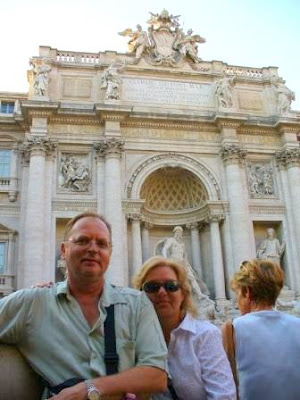
At the Trevi Fountain - Andre & Monica. Picture taken by a kind Indian man.

The Trevi Fountain in Rome, Italy. Well worth a visit. More so than any of the other fountains. The fountain, designed by Nicola Salvi in 1762 in elaborate baroque design, is centered by Neptune, and flanked by two Tritons, one trying to control an unruly seahorse and the other leading a quieter beast, symbolizing the contrasting moods of the sea.

Dinner by candlelight on the terrace of Apartment Morandi in Rome.

Tuesday, June 19, 2007

A Day Among the Ruins of Rome

Late on the 3rd day of our Italy excursion, after we did some shopping at the local supermarket, we took a bus to Piazza Venezia, as close as you will probably get to a center of Rome. We tried to get on an open, sightseeing bus, the red 110 as advised by most visitors to Rome, just for a familiarization tour of Rome. We did the same in London and New York and it is usually well worth the money. You see the city from a different viewpoint. But after an hour’s wait and 2 buses later, we gave up. They only wanted to sell us 2 day passes and no 2 hour tickets even though the buses were only half full. Well, I was not going to fork out €20 a ticket just to comply with their “marketing strategy” and be taken for a ride, excuse the pun.

From the Piazza I explored the Il Vittoriano, the Monument Victor Emmanuel II, climbing all the way to the top to snap photos of the Rome skyline, while Monica and Lamar waited in a shady spot.


The Monument Victor Emmanuel II, Piedmont king that became the 1st king of the unified Italy in 1861.

We walked around the monument to explore the Roman Forum, starting from the Capitoline Hill in the north to the Colosseum in the south. We entered the Forum through the Arch of Septimius Severus, crossing Via Sacra numerous times from west to east as we looked into the reconstructed Curia (Roman Senate), discovered the Temple of Castor and Pollux, passed the House of the Vestal Virgins, ogled the heap of ground where they claim Julius Caesar was cremated, stopped and watched a group of young archaeologist excavating more historical facts or another treasure from the past, explored the Temple of Venus, passed through the Arch of Titus, then on to the Arch of Constantine in front of the Colosseum. At this world famous landmark we decided to take a paid tour because it also included a tour through the forums of Augustus, Trajan and Julius Caesar.

The backside of the Palazzo dei Senatori on the Capitoline Hill seen from the Roman Forum. One can clearly see how new buildings are simply build upon older ruins. The bottom layer dates from about 100 BC and on the inside we saw some of the excavations. The next picture was taken standing in the center arch above.

The Roman Forum seen from Palazzo dei Senatori. On the left is columns of the Temple of Vespasianus and on the right is columns of the Temple of Saturnus.

It is quite common that one emperor will undo the work of a previous emperor (that’s what emperors do), but it is such a pity that so much of the various ancient forums were destroyed by Mussolini when, in a moment of self-indulgence, he ordered the building of Via Dei Fori Imperiali so that he could have a direct line of sight of the Colosseum from his office in the Palazzo Venezia.

Me, Roman Soldier! At the Colosseum you can have your picture taken with these guys for a Euro. If you take a photo of them without their permission they will come after you and demand you delete a picture from your camera. Any which way to make a buck out of tourists.

Highlights of the day were the Colosseum, the reconstructed Curia (Roman Senate building), the view from the backend of the Capitoline Hill overlooking the Roman Forum and the 3 remaining ancient Arches in Rome. Late in the afternoon, after all the walking, we rest our feet in the cool waters of a fountain in front of the Victor Emmanuel Monument while eating gelato.

The Colosseum from the top level. All that is left of the arena floor are the walled passages that were below the floor level.

The Arch of Constantine seen from the top of the Colosseum.

Inside the Colisseum - Monica and Andre. No smiles? It was hot! We just climbed many steep steps to walk around on the top level (like taking the previous photo), walked down again and there was still an hour's walk ahead of us down Via dei Fori Emperiali through the Forums of Augustus, Trajan and Julius Caesar.

After taking the right bus, but in the wrong direction, we ended up in Trastevere on the wrong side of the Tiber River. A little bit of “travel experience.” With a little help from a friendly Italian gentleman we got off our incorrect bus, took another back to Piazza Venezia and then caught a cab to our apartment. From then on we used cabs extensively as we did on previous travels to New York. It is not always more expensive and it certainly doesn’t waste our time waiting on buses, taking detours, etc. When you travel you usually have limited time and you must use the time to the best of your ability and try to save on the legwork.

Rome's ancient center is very imposing. This was the Rome we came to see. Walking the ancient street of Via Sacra, standing at the wall on Via Della Curia overlooking the Forum, wondering what it was like 2000 years ago, imagining how Trajan’s Forum really looked in its heyday filled with hundreds of shops and vendors and thousands of shoppers, and visualizing what it would have been like to be part of 55,000 people watching a gladiator contest in what must have been an extraordinary building, the Colosseum, with its imposing layers of Doric, Ionic and Corinthian tiers. Tiers which inspired so many Renaissance architects, but they also plundered the building to build other masterpieces like St. Peter’s basilica, our destination for tomorrow.

Excavation inside the Forum area still continues today.

Trajan's Forum

Monica: At the end of the day, a moment in thought, on Via della Curia overlooking the Forum,
wondering what was it like down there 2000 years ago!!!