Showing posts with label Family. Show all posts

Thursday, July 19, 2012

Geheimsinnige Hugenote


OMG! Die reuk van reën op bare gebarste kleigrond en die omsingellende koelte na weke van moordende hitte is soos om van te dans in die reën. Hitte soos dié het ons nog nooit in Kentucky ervaar nie. ‘n 100 plus grade Fahrenheit (37 grade Celcius) hier of daar elke 5 jaar of so maar nie 9 dae agtermekaar nie. En dit nadat ons vir 6 weke amper geen reën gehad het nie. En toe dit een dag net 95 grade Fahrenheit is sê ons “dis nogal koel vandag.” Wanneer praat ‘n mens van 95 grade en koel in dieselfde sin?

Aanhoudende hitte soos die het ek laas ervaar toe ek ‘n twintig jarige konskripsie snotkop was wat denkbeeldige ANC terroriste in Vhembe, wes van Weipe and Musina, in die Limpopo provinsie van Suid Afrika, moes najaag en die agterdeur na Botswana moes bewaak terwyl hulle in hordes by die Mozambique voordeur in gestroom het. Ek het later tot die slotsom gekom dat ons eintlik maar net die generaals se jagplaas naby Vhembe, net noord van Alldays beskerm het en gekeer het dat onsuiwere karakters nie hul blikkies bully beef en Koo uie-en-tamatiesous kom steel nie. Om nie eens te praat van die toegesluite kaste vol Kaapse Pinotage nie. Nie dat hulle ooit blikkieskos geëet het nie, dis nou die generals, want wild was volop en skiet was lekker. Ons konskriptes moes maar tevrede gewees het om 2 weke se kos, meestal mieliepap, wat ons laatnag uit die kantien gesteel het, en army rations op ons rue te dra en deur snikhetende bospaadjies strompel terwyl mopanie vliee, die locals noem hulle mos mokabye want hulle maak so ‘n halwe teelepel heuning in klein gaatjies in die mopanie bome, op ore, oë, neusgate en monde afgeduik het soos manlike spermselle op ‘n onbevrugte vroulike eier.  Spore van terroriste is nooit gesien nie, net die van luiperde en olifante en wild. Wat ‘n waste of time en effort was dit nie op die ou einde nie.  Maar deur die eeue heen is jongmans mos maar so geknie en gekarnuffel en voor in die linies gestoot ten koste van die behoud van of adelike bewind, of landsbeskerming of nasiebou.


Vhembe in die verre noorde van Suid-Afrika. Die land van reuse kremetart bome van tussen 300 en 500 jaar oud, die mooiste oranje sonsondergange, ou koninkryke, en pragtige Afrika natuurskoon.

Praat van nasiebou. Die afgelope week of twee dink ek soms aan Marie Grillion. Sien, ‘n maand of so gelede het ek ‘n pakkie uit Suid-Afrika gekry wat my skoonsus aangestuur het. Ek het seker laas ‘n pakkie gekry toe ek op die Suidwes-Afrika grens was in dieselfde bogenoemde patrollie-loop-terroristejag-oorlog, maar toe teen SWAPO, so ’n jaar of drie voor die Vhembe uitstappies. Doerietyd se pakkies was gevul met tuisgebakte (verkrummeld teen die tyd dat ons dit gekry het) Jan Smutsies en soetkoekies, biltong en kondensmelk (lopende goud in die army), maar my onlangse pakkie het spesifieke klere, springbok biltong (wat die Amerikaanse doeane gekonfiskeer het, bastards! hulle het my nogal ‘n mooi nota in die box gelos om te sê wat hulle gevat het) en inligting bevat. Inligting wat ek al lang na soek. Inligting oor die Malherbes. Inligting oor Marie Grillion, the stammoeder van die Suid Afrikaanse Malherbes.


Vir jare nou al is ek besig om my stamregister saam te stel. Nie die maklikste taak onder die son as ‘n mens ver van geskiedkundige inligting aan die anderkant van die Atlantiese Oseaan sit nie. So daar word baie emails gestuur en mooi gepleit vir samewerking en baie gehoop ander sal van hulle kosbare tyd afstaan om my indulgence vir inligting te verwesenlik. Waarom die Malherbes? Wel my ma was ‘n nooi Malherbe.


Dit will blyk, uit die inligting wat ek bekom het, dat Mademoiselle Marie Grillion ‘n tawwe tannie was en ietwat gehul in geheimsinnigheid. Sy’s of gebore in 1670 naby Mer, Frankryk, in die destydse graafskap van L’Orléanais, in vandag se Loire vallei, suidwes van die stad Orleans, of in 1673  as Marie Gruyon in Balinghuem, naby Calais, Frankryk. Bronne verskil. Daar is ook onsekerheid oor wanneer sy aan die Kaap geland het. Ek dink nie die hoe sy aan die Kaap aangeland het is ‘n kwessie nie, sekerlik met ‘n skip. Maar haar naam or enige Grillion naam verskyn nie op enige van die skeepsjoernale van die Franse Hugenote wat na die Kaap geimmigreer het nie. Dus om in 1688/89 as ‘n 15 of 18 jarige ongetroude meisie in ‘n barbaarse Kaap te land, blykbaar sonder ouers of ‘n chaperon, is nie eintlik dieselfde as wat ‘n  meisie wat vandag in Johannesburg op ‘n vliegtuig klim na London en ‘n plekkie in Shepherds Bush uitskop nie.  Daardie tyd was die Kaap maar rof en die manne nog rowwer en meisies was skaars en min en naarstiglik nagejaag om die voortplantingsproses te begin of om sommer net die eensame lewe minder eensaam te maak. ‘n Man kan mos ook nie net heeldag werk en elke aand in die tavern of the seas deurbring nie.

 Nederlandse skip in Tafelbaai

Was sy ‘n stowaway op een van die bote? Not likely. Het sy incognito ge-travel op ‘n vals paspoort?  Ditto. Was sy moontlik ‘n weeskind en wel onder toesig van een van die ander Hugenote wat op die skip Voorschoten aan die Kaap geland het, maar sy is net nie so opgeteken nie. Sekere bronne bespiegel dat sal dalk op die lang reis vanaf Delfthaven, Nederland op die skip getroud is met Gideon Malherbe. Ek betwyfel dit want dan sou dit tog so op geteken gewees het. Veral omdat Gideon duidelik opgeteken was en waar ander Hugenote se vrouens of kinders hulle vergesel het was hulle ook opgeteken. Nee, Gideon word deurentyd in bronne opgegee as “jonkman” of “jongenheer” wat beteken hy was ongetroud toe hy aan die Kaap geland het.      


Rondom 1690 is sy getroud met Gideon Malerbe (1663-1723] (spelling sonder die h volgens die NGK Moedergemeente Stellenbosch Doopregisters 1688-1732). Hierna verskyn Marie se naam op verskeie dokumente maar altyd as Gideon Malherbe se vrou. Dis opgeteken dat Marie en Gideon hul eerste kind op 8 Julie 1691 in dié kerk gedoop het.  Gideon, die Malherbes se stamvader, is opgeteken as ‘n passasier op die Voorschoten, die eerste skip wat die offisiële immigrasie van Hugenote in 1688 begin het. Daarna het omtrent 225 Franse hulle kom vestig aan die Kaap. Nie ‘n groot aantal nie as ‘n mens dit vergelyk met die 200,000 Hugenote wat uit Frankryk gevlug het nie, maar voor hul koms was daar aan die Kaap en in Stellenbosch net 254 wit mans, 88 vroue, 119 seuns, 112 dogters en 39 knegte.  Daar het ‘n paar verdwaalde of avontuurlistige Fransmanne aan die Kaap aangekom voor 1688. Hulle het seker maar die skrif aan die muur gelees nog voor ou Louis die Edik van Fontainebleau in 1685 geteken het.        


Franschhoek (from the Cape Town Gazette)

‘n Paar jaar na hul troue in 1690 het Gideon en Marie hulle gevestig op die plaas Normandie in die French corner, Franschhoek vallei, wat aan Gideon toegeken is in 1694. Maar daar is ook baie onsekerheid oor Gideon Malherbe. Daar word vermoed dat hy in Loans, Normandy, Frankryk gebore is en daarom sy plaas Normandie genoem het. Daar was altyd en is vandag nog baie Malherbes in Normandy, Frankryk. Maar in bronne oor Hugenote wat Normandy uitgevlug het verskyn sy naam nie. So wanneer hy in Holland aangekom het en wat hy daar gedoen het voor sy vertrek na die Kaap is duister. En wat Gidion tussen 1688 en 1694 aan die Kaap gedoen het is ook onbekend. Ons weet wel dat hy nie lank op Normandie gebly het nie want kort na 1700 het hy na Wamakersvallei getrek (vandag Wellington) en in 1702 het hy die plaas De Groene Fonteyn geerf en ook later die plaas Hexenberg gekoop. Nie dat hy Normandie verkoop het nie. Dit het in familie besit gebly tot 1734 toe dit aan Gideon se skoonseun Jurgen Radijn verkoop is en Jurgen dit in 1744 aan Jan De Villiers van Boschendal faam verkoop is. Maar meer oor Gideon en sy, sommige duistere mannewales op ‘n latere stadium.


Vandag is die plaas Normandie nog presies daar waar dit 318 jaar gelede aan Gideon toegeken is. Dis geleë tussen Paarl en Franschhoek op die R45, aan die suide kant van die pad net na die brug oor die Dwarsrivier, geleë tussen die plases Boschendal en L’Ormarins. Ek dink dit behoort vandag aan die bekende perderesies Maingard familie wat ook Dieu Donné en La Cotte in die Franschhoek vallei besit. Daar is wel ander Malherbe nasate wat nog steeds wyn bedryf in die Franschhoek vallei, byvoorbeeld Eikehof.


En Madame Marie? Wel sy sou nog 22 of 23 jaar lank na Gideon se afsterwe bly lewe en bly boer op Hexenberg en die ander twee plase wat sy geerf het van Gideon. Dit wil blyk dat sy in die boerdery gehelp is deur haar enigste oorlewende seun Pierre. Soms was sy eerbaar en soms het sy wit leuens aan die owerheid vertel vir onbekende redes, soos die keer in 1713 toe sy ‘n opgawe moes maak oor haar besittings en gesê het haar man het aan natuurlike oorsake gesterf. Die waarskynlike waarheid was en sy het dit glo later “erken” dat Gideon en drie van haar kinders (moontlik net 2 kinders (Susanna and Gideon) want hul eerste kind, Gideon, gebore 1691, is moontlik dood voor 1702 omdat ‘n verdere kind genaamd Gideon in 1702 gedoop is) in 1713 aan “pokkies” smallpox dood is. Daar word gereken dat in 1713 tot 1585 Europeërs (meer as 800 was kinders) in die Kaap  aan pokke gesterf het. In ‘n verslag aan Nederland het die owerheid gerapporteer dat daar skaars “20 gesonde mense in die Drakenstein is”.      

Tuesday, April 20, 2010

Nuwe Toevoeging Tot Die Familie

Om 7.54 vm vanoggend het die familie hier in Amerika ’n nuwe toevoeging gehad om die familienaam voort te dra. Genaamd Ian, die kleinseun het in geweeg teen 7.10 lb / 3.2 kg.

Hulle sê, ek is tans in Mexico, hy lyk glo nes die pa en oupa (net meer hare), maar dit moet seker maar die familie gelaatstrekke wees wat deur slaan. Ek self kon nog nooit die kuns aanleer om babas met grootmense se gelaatstrekke te vergelyk nie. Babas is babas. Almal lyk min of meer dieselfde.

Nietemin, Welkom Ian.

[Oupa sal hom moet leer om 'n liefde te ontwikkel vir rugby...maar net kyk...die gespeel daarvan laat te veel arthritis gebeendere as 'n legacy.]

Het sekerlik meer hare as ek.

Ousus Marley kyk verwonderend na die nuwe boetie.
Haar middagete in die agtergrond is totaal en al vergete. 
(Sy het glo vroeer die week vir Ouma gesê sy het twee nuwe “blothers”...Baby Ian and baby blother)

Friday, July 31, 2009

Who's That Baby?

Strange how the human psyche works.

This past weekend “Poeksie” was rummaging around and pulled out a photo of her we took last year.

“Who’s that baby?” I asked

Without batting an eye she replied: “Oupaaa, I not baby. I big girl now.”

It seems our brains are genetically programmed to want to turn the clock forward faster when we are little. Aspiring to be teens or adults!

But by the time we get to 40-45 we drastically wish we could turn the clock back again to the time that we can remember as the best time in our distant youth.

Since I haven’t posted a picture of Poeksie lately here are a few.

All eyes on the birthday present.

In her favorite push car. "Come on Oupa...Push"

Clowning around.

Oh, but this is nice.

Friday, September 5, 2008

Little Rabbadoe

Just the other day she was barely a foot long. Now she's all over the place, lightning fast and Oupa and Ouma have trouble keep up.

Pretty in Pink

Clowning around.

Helping Oupa in the garden. Teach them young and they might just develop a life-long love for gardening.

Late afternoon with Ouma at the Louisville Zoo: Hot, bothered and "pap tires"

Little Rabbadoe.

Tuesday, March 11, 2008

Growing Up Fast

Pictures of the granddaughter after special requests from family and friends in South Africa.

1 year old and growing up fast

Playing house inside her tented kitchen.

Hard not to love a face like that.

In her favorite place, Ouma's arms.

"Little Red Riding Hood"

Make that Pink and Red Furry Riding Hood

Monday, February 11, 2008

The Hanekom Family History

Like most people, I am also interested where I come from and being a lover of history I am naturally drawn to the questions and riddles of family history and family trees. My own family genealogical tree is still a small work in progress.

But I came across the below-published document during my research. It looks like the kind of thing that those stands in shopping malls in South Africa use to sell, those “family certificates.” I think it is totally fabriated for commercial purposes. Credit to Kyle Hanekom (per the original post) who published this first.


The Hanekom Family - European History

Throughout our research into the histories of names, we have found that names undergo tremendous changes over time. Scribes often recorded a name based on its sound, and since there are so many different regional dialects, many different spellings occurred, often between the generations. Among the many variations of the name Hanekom we found Hane, Hanecop, Hanecourt, Haneffe, Hanegraaff, Ganegreve, Hanel, Haneman, Hanen, Hanenberg, Hanens, Hanequin, Hanet, to name a few examples. Situated between East Friesland and the Weser river, the former free state and grand duchy of Oldenburg became part of Lower Saxony in 1946. Settled by the Saxons and the Frisians, the land was divided into several counties, of which Oldenburg became the most prominent. Documents show that Elimar I ruled Oldenburg from 1088-1108, and that the Archbishop of Bremen and the leaders of Oldenburg were often struggling for power. Although the Counts of Oldenburg were no allies of the Archbishop, they agreed that the fiercely independent Frisians should be assimilated. The Frisian farmers and fishermen, who had settled the North Sea coast, enjoyed "Frisian Liberty" under both the Roman and the German emperors, and they fought hard against political interference. In 1160, the Saxon Duke Henry the Lion and Count Christian of Oldenburg lost over 2000 knights in their attempt to conquer the Frisian Jeverland. In the 13th century the Archbishop of Bremen pillaged the Stedinger land, whose people opposed his enormous taxation.

In the meantime, the Counts of Oldenburg enlarged their domain in the west and the east by acquiring Ammerland and Delmenhorst. In 1448, Count Christian was elected King of Denmark and the county fell to his brother Gerhard. With the assistance of the Duke of Brunswick, the counts conquered the Frisian lands of Butjadingen and Stadland. The Reformation came with Anton II whose grandson Anthon-Guenther was the most popular ruler of the House of Oldenburg. He kept his land neutral in the Thirty Years War, and his domestic policies encouraged commerce and education. After his death the family line became extinct, and the county fell to Denmark in 1667.

Meanwhile the family Hanekom moved to Oldenburg, where the Hane family held many diverse interests. During the 16th century, Europe experienced a general population explosion which led to mass migrations of people throughout the continent. Members of the family participated in this mass movement, relocated and established themselves in new areas as they pursued their special interests in religious, military and political occupations. They branched into Saxony, Denmark, Switzerland, Holland, Flanders, and France where they held titles and estates. The French branch was raised to the nobility in 1648 and became Counts in 1768. The German branch became Knights in 1674. Notables of the time included the Hane family of Lower Saxony. After the Treaty of Westphalia in 1648, the bishops of Muenster abandoned their claims to the predominantly Catholic regions of Vechta and Cloppenburg, still known today as "Muensterland". The mostly Frisian north was incorporated and Emperor Joseph II proclaimed the land of Oldenburg a dukedom. The throne belonged to the future Czar of Russia, Paul, member of the House of Holstein-Gottorp, and he in turn gave the duchy to his cousin Friedrich-August. The Gottorps ruled from their possession in Oldenburg-Eutin. During the rule of Grand Duke Peter, Prussia bought land in the lade Busen (Bay) and built the naval port Wilhelmshaven.
After the Great War and the abdication of the monarchy, the Grand Duke Friedrich August abdicated, an act followed by a failed revolution. Oldenburg suffered little damage during the Second World War and it became a haven for many German refugees fleeing the East.

After 1650 many Germans left their homeland for the New World. Settlers bearing the name Hanekom where among those who traveled to the New World and established themselves along the eastern seaboard in the United States and Canada in the 18th and 19th centuries. In the United States they settled mainly in Pennsylvania, New York, Texas, Ohio, California, and Illinois. In Canada, German settlements centered around Ontario and the Prairies.

Notes: With regards to a coat-of-arms: A lot of it is myth. Few people who use a coat-of-arms and/or so-called family crest today have any right to do so. Armorial bearings do not belong to all persons of a given surname, but belong to and identify members of one particular family who has the legal right to the coat-of-arms. Coats-of-arms are a form of property and may rightfully be used only by the male-line descendants of the individual to whom they were first granted or allowed. Such grants were and are made by the appropriate heraldic authority. [Extract from an email from Anne Lehmkuhl to the West Gauteng branch of the Genealogical Society of South Africa.]

The Hanekom Family - South African History

The first Hanekom that emigrated to South Africa is Jürgen Hanekom, also spelled Jors Hannekoom or Hannekom, of Rathlosen near Sulingen in Hannover (Germany), born 1688 and died 1752. He moved to the Cape of Good Hope in 1708 was a woodcutter.
[Source: Names of German Immigrants 1652 to 1806 - http://www.safrika.org/Personalia_en.html.]

But for a far more indepth listing of the Hanekoms and related families visit the website Die Familie Hanekom, which was recently created by Johann Hanekom.

Tuesday, November 27, 2007

25th Anniversary


Today, exactly 25 years ago, on a sunny Saturday afternoon in Thornton, Cape Town, I married my high school sweetheart.


I feel we still have another 25 years in us, and I would not want to spend it with any other person.

Monday, July 23, 2007

Granddaughter news

Six month old and I now eat baby food. I try to eat by myself but it is still a mess.
Crashed out with Ouma on the stoep.
Hey there. Long time no see.

I started to crawl and you better watch out. I am getting good and fast at this.

I just looooove spending time in the spa with my toys.

Tuesday, April 3, 2007

Showing the first signs of a personality

It is a bit more than 3 months since the birth of Marley Ray and a little personality is coming forth as can be seen in these pictures.

"I really don't like things on my head, but for once I will let you take my picture with a cap"

"Ah, It's so much better without the cap"

"This toy has become my favorite since I started with the dreadful issue of teething"
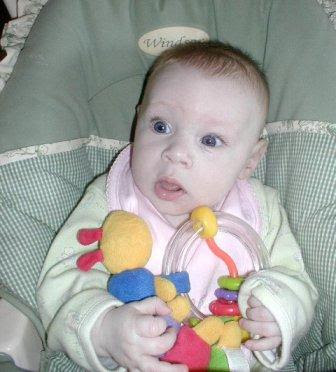
"You want me to do what? I have no idea what you're talking about!"

"Huh...really. Is the photo session over? Will I be a supermodel?"

"Now then, a girl never tells all her secrets. Got to leave something for you to wonder about."

"You will have to excuse me now. After all that playing and acting a girl's got to get her beauty sleep.'


Friday, December 8, 2006

A New South African American - 'n Nuwe Baobab Steggie

Today we became Grandparents of a new South African American. Our first granddaughter: Marley Ray Noelle Hanekom. Born 12/8/2006.