
 Everyone tells you the Vatican is a must and I can confirm that. Saint Peter’s basilica is absolutely incredible. I thought Westminster Abbey was spectacular and it is, but so is St. Peter’s. The artwork inside the basilica, the spectacular dome and especially Bernini’s high alter are well worth the visit. Monica thought Pompeii was going to be the highlight of our trip, but she said after the Vatican visit that this was even better.
Early morning we took a taxi to the Vatican and got in line for a visit to the museum and the Sistine Chapel. It was only just past nine and the line was already very long. To our surprise the people in front of us was South Africans from Johannesburg and speaking to them in Afrikaans, discussing each others travels, made the hour long wait in sweltering heat more enjoyable. Actually, we heard Afrikaans spoken in Pompeii, in the Roman Forum and in Venice.
Art is like wine to me. Don’t describe a red wine in terms of bold blackberry, red plum, kirsch, tobacco and minerals flavors with undertones of cedar and stone and a lingering after taste of mocha and expresso. It sounds like someone has made me a cocktail. What is kirsch? And how should I know what is the taste of cedar and stone? It’s not like I walk around licking trees and stones and file those tastes in my memory banks for them to be recalled when I sip a red. I know when red wine is just good, or when it has real class or when it was made from grapes grown in the backyard and from a recipe obtained from the Internet. Art, to me is very similar. To try and describe the Vatican’s art collection in grandiose terms is not within me. I can appreciate good art when I see it and the Vatican museum and chapels are packed with good, some brilliant art. Some of the statues and pieces d’art are simple magnifico.
We did not go to all the rooms, for example, we skipped the Egyptian rooms, but concentrated more on the rest. I also have to mention that we spent only about 5 hours in the museum and it was not all that much fun either, because the place was packed with people. In some areas it felt like you are on a conveyer belt as the crowd pushed and shoved forward and, in others the heat and number of people in the room made it not impossible, but uncomfortable to really appreciate the art. An example of this was the Raphael rooms. In the Sistine chapel (it seems everybody is just focused on getting to the Sistine chapel) it was so jam-packed I swear you could try to fall down but the bodies would keep you from reaching the floor. Luckily I found us a place to sit in the center of the chapel where we could rest our feet and appreciate the ceiling in relative peace. But to really appreciate the work of Michelangelo Buonarroti I would suggest you bring binoculars because the ceiling is too high to see the fine detail. Fortunately I brought my Eyewitness Travel Guide on Italy with me and we could see the ceiling paintings in close up and we also had our rented audio information guides for comments. Then there is also the Fresco of the Last Judgement which covers the complete wall behind the altar. Apart from the magnificence of the actual paintings, Michelangelo’s understanding of religion and the way he was able to express that understanding is simply masterful and that at a young age of 33. If you add the fact that he sculptured David and the Pieta before he turned 30 you understand why he is so revered as the greatest artist in the Western world.
After we had a terrible and expensive pizza in the Vatican Restaurant we sent a postcard to family in South Africa from the Vatican Post Office and then made out way to St. Peter’s Basilica. The line to go through security was not too long. I will let the pictures tell the story about the basilica.
Afterwards we took a taxi home, rest for an hour or so and then Monica and I rode by bus to Piazza Venezia and went on a casual, pre-dinner Rome walkabout. The evening air was cooler and we walked to the Pantheon (the best preserved building from the Roman period in Rome,) then to Piazza Navona (unfortunately the famous fountain was being repaired), ate gelato on our way to the Trevi Fountain (she liquorish flavor and I cappuccino flavor) and then to the Piazza di Spagna or the Spanish Steps (we knew beforehand is was not going to be anything special and it wasn’t, but more a case of been there…done that. We caught a taxi home and I made us a quick dinner of tortellini carna con pomodoro e basilica and a mixed green salad with an herbal sauce. I lit some candles out on the terrace of the apartment and while Monica enjoyed a Bicardi Breezer I enjoyed a few glasses of a Poggiatico Chianti. It was not the best Chianti in the world, but it was about the food and the atmosphere. The end of a perfect Roman day!

 Closed off hall with gilded ceilings near the Vatican Museum shop.

A Double Helix Staircase designed in 1932 by Guiseppe Momo. One spiral to walk up to the exhibits and one to exit the museum.
Vatican Museum - Maps Gallery with incredible ceiling paitings in vivid colors.

Vatican Museum - Floor Mosaic.

St. Peter's - As we entered the church a ray of sunlight streamed through the dome windows on the altar. No picture can really convey the enormity of the church, the largest in the world.
 St Peter's - High altar designed by Bernini in1624. The baroque canopy stands over the tomb of the St. Peter. Personal opinion: The most striking piece of art in St. Peter's. It is simply magnificent.
While we were standing in front of the altar, looking down to St. Peter's tomb, a little gilded box, I guess containing his bones, a woman standing next to Monica, shivering and her arms covered in goose pimples, said to her traveling companion, "I am experiencing a religious moment right now."

St. Peter's - Michelangelo's Pieta, another one of the many masterpieces in the church. It is hard to believe one can create such delicate art from a block of marble.

St. Peter's - The Vatican Guards at a side entrance.
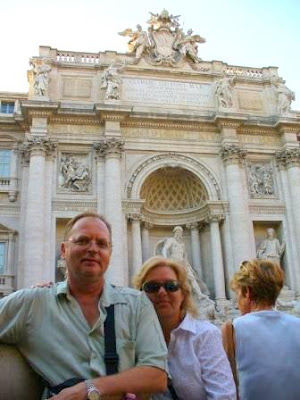 At the Trevi Fountain - Andre & Monica. Picture taken by a kind Indian man.

The Trevi Fountain in Rome, Italy. Well worth a visit. More so than any of the other fountains. The fountain, designed by Nicola Salvi in 1762 in elaborate baroque design, is centered by Neptune, and flanked by two Tritons, one trying to control an unruly seahorse and the other leading a quieter beast, symbolizing the contrasting moods of the sea.

Dinner by candlelight on the terrace of Apartment Morandi in Rome.


