Saturday, March 10, 2007

Monterrey - The Sultan of the North


On a recent visit to Monterrey I spent a delightful evening in the Barrio Antiguo (old Neighborhood) , the oldest area of Monterrey, Mexico with its narrow, cobbled-stone streets and stone buildings, mostly old houses that dated back to the 17th and 18th century that used to belonged to the people that originally established themselves in Monterrey. I went to dinner with colleagues of mine at an Italian ristorante named Iannillis. The barrio, located behind the Metropolitan Cathedral, can probably be seen as the center of nightlight in Monterrey. Many of the city’s bars, clubs, restaurants and nightclubs are in this area and they are all close together, so bar hopping is a popular thing to do by the younger crowd.
Old Houses in the Barrio Antiguo

Looking through my previous post I was amazed to see that I have never really written about this northern city of Mexico, sometimes called the “Sultan of the North”, which I frequently visit for business reasons.

Without delving too much into history, I do tend to go over the edge on this, Monterrey was founded in 1596 by Don Diego de Montemayor and named the city in honor of the Viceroy of New Spain. A flood in 1612 washed away most of the original city, but a footprint of the Spanish era can still be seen in the Barrio Antiguo.
The city is not really a tourist mecca because it does not have much to offer in terms of pre-Hispanic culture or colonial elegance, nor does it have green valleys of vineyards or any other agricultural draws. Located south of the Texan border in a desert region, Monterrey is a valley surrounded by the jagged peaks of the Sierra Madre mountains of which the Cerro de la Silla, “saddle mountain” is the most recognized. It is though the commercial capital of Mexico, and some of the biggest companies in Mexico, i.e. Cemex, Vitro, and several others, are headquartered here.


This picture of the Cerro de la Silla was taken from within the MARCO museum.
The Barrio Antigue is in the foreground.

Although it lacks old world charm, it does have a European flair and a lot of “Americana” feeling about it. The heart of Monterrey is the Macro Plaza. On one of my weekends that I stayed over in the city I explored many of the sites. The Saturday morning I went to the Museo de la Historia Mexicana, which sits on top of a natural spring. I would give the museum is fair to average rating. Although it covers most of Mexico’s history, it is seriously short on good exhibitions. Adjacent to the museum is the tranquil Paseo Santa Lucia, the spring’s outflow, with many café’s on the side of the canal. From there I walked to the northern end of the Macro Plaza, past the Justice Building to the Palacio del Gobierno (the Federal Palace), which house several government departments, but open to the public, and then to the Fuente de la Vida, a colonial style Neptune fountain in the center of the Plaza. I spent the rest of the day walking the streets of Monterrey, especially the Zona Rosa to get a good feel of the city.

Piece of art in the Museo del Vidrio

The Sunday two colleagues and I took a taxi to visit the Glass Museum, the Museo del Vidrio, which is located on the premises of the Vitro Glass Company. This was quite interesting and housed some excellent examples of how glass can be use as an artistic and sculptural medium. At the time of our visit they also had a special exhibition of Napoleon Bonaparte – porcelain, clothes, furniture and many other articles of Napoleon and his queen Joshephine. From there we walk to Av. Cristobal Colon to the Railway Museum (give it a skip) and next door to the Cultural museum (another skip, you miss nothing).
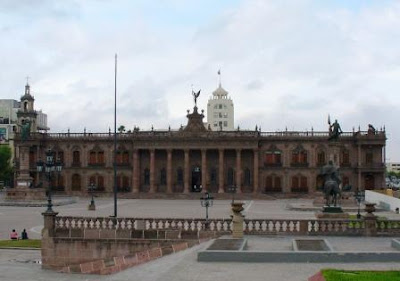
The Palacio del Gobierbo by day and by night.


From there we took a taxi to the Metrolitan Museum, which is located in the oldest standing building in Monterrey. In this building, strangely, hidden behind a cupboard now, are a room and a desk on which the USA and Mexico signed the Maquiladora contract (Inter-country trade agreement.) I say strangely, because the agreement had such a major impact on the border cities of Mexico and Monterrey in terms of job creation from US manufacturers. The museum has a small section dedicated to Monterrey’s history, and the rest is dedicated to modern art of various mediums. There was some interesting stuff there. From there we went to the Museo de Arte Contemporaneo (the MARCO museum). The front of the building is guarded by a gigantic bronze sculpture named "La Paloma" (The Dove), by Mexican artist Juan Soriano, considered the symbol of the museum. Touted as the largest art museum in Latin America, I was not very impressed with the art at the MARCO or maybe it was late in the day and I was rather tired by then. The central patio inside with its huge water feature is quite impressive though.

Entrance to the MARCO, the Contemporary Art Museum

Next door to the MARCO is the Metropolitan Cathedral, built between 1600 and 1750 and down the road is the Faro del Comercia, the Tower of Commerce, which dominates the landscape of the Macro Plaza, and is the highest monument in México. Most nights a beam of red or green laser lights circles the city from atop the tower, making for some interesting effects when it scans the nearby mountains. Behind the Cathedral, on the western side of the Plaza is the Barrio Antiguo with its old and colorful buildings, an excellent place to wander through and look at the old buildings, interesting doors and windows.

Metropolitan Cathedral and front detail (below).


There are still several places I want to visit in Monterrey, especially the Planetarium, which I heard is quite good, and then I would like to visit the Museo del Obispado (the former bishop’s palace), built in the 18th century.

Monterrey has excellent restaurants and I have eaten at several of them. The regional specialty is Cabrito, baby goat meat, which is similar to lamb. Here it is mostly slow cooked over mesquite coals, or many hotels offer it at breakfast. Another popular steak choice is Steak Arrachera, marinated flank steak, and a good alternative to T-bone or Rib-eye steaks. My favorite is to visit local neighborhood restaurants for Taco’s or Fajita’s, which usually comes with Queso Blanco, a white cheese that is melted and topped with crumbled, spicy Chorizo sausage. Because of there freshness the tortillas in Mexico is far superior in taste than the ones you get in the US. (dah…)

I left Monterrey last Friday with disappointment, in myself, because I should have planned better. On my way to the airport I heard on the radio that Roger Waters, ex-Pink Floyd bassist, was performing that evening in town. I certainly would have stayed over until the Saturday and attend the concert if I knew this beforehand. These days I travel to Monterrey once a month and in future I will check what’s happening on the entertainment front when in town.

Upon our return from the Sunday sightseeing our taxi had a flat tire and the driver had to reapir it at the side of the highway. After the repair the car wouldn't start and we had to give it a push start.

My rendition of a postcard picture available in Monterrey. Taken from the front of the MACRO with the Commerce Tower in the center and the Cathedral on the right.

An active workshop inside the Glass Museum. A glass stained window in progress.

Golden tea set from the Napolean Bonaparte exhibit at the Glass Museum.

Fuente de la Vida - Neptune Fountain.

Tuesday, February 13, 2007

Truth or Untruth - Crime In South Africa

In 2000, Jim Peron wrote: There is a joke going around: Americans have Bill Clinton, Johnny Cash and Bob Hope. South Africans have Nelson Mandela, no cash and no hope. See Die, the Beloved Country (South Africa)

A joke that was send to me last week:

The Kaizer Chiefs manager flies to Baghdad to watch a young Iraqi play football and is suitably impressed and arranges him to come over to South Africa. Two weeks later Kaizer Chiefs are 4-0 down to Supersport with only 20 minutes left. The manager gives the young Iraqi striker the nod and on he goes.

The lad is a sensation - scores 5 goals in 20 minutes and wins the game for Kaizer Chiefs!
The fans are delighted, the players and coaches are delighted and the media love the new star.

When the player comes off the pitch he phones his mum to tell her about his first day in South African football. "Hello mum, guess what?" he says in an Iraqi accent. "I played for 20 minutes today, we were 4-0 down but I scored 5 and we won. Everybody loves me, the fans, the media, they all love me."

"Wonderful," says his mum, "Let me tell you about my day. Your father got shot in the street and robbed, your sister and I were ambushed, gang raped and beaten and your brother have joined a gang of looters and all while you were having such great time."

The young lad is very upset, "What can I say mum, but I'm so sorry."

"Sorry?!!! Sorry?!!!" says his mum, "It's your bloody fault we moved to Johannesburg in the first place!"

Crime has become the biggest talking point in South Africa, and rightly so. According to First National Bank's statistics:

420,154 citizens were victims of violent crime in 2006,
18,528 murders were committed,
54,926 rapes took place, (1 every 9 minutes)
119,726 violent robberies were executed.

Anti-crime websites and blogs are blooming like tulips in early spring. Some websites are even talking genocide, especially when referring to the systematic killing of White farmers. To many there is a startling similarity between these killings in South Africa and what has happened in Zimbabwe under Robert Mugabe, where all white farmers have been either killed or dispossessed of their property. Today, Zimbabwe is still a killing field, a place where one man is killing a people of the country, his own people, a genocide of the highest order. Is this a South African genocide in the making?

Systematic is a strong word and to lay that at the feet of a government is an even stronger action, but if crime is so widely reported and a government is not doing anything definitive about it or in some cases flatly denied it, then suspicions of government involvement or approval of these acts are all that’s left. On the one hand you have the government and people close to the ruling class that say or insinuate that crime statistics are being taken out of context or are being unfairly reported to put the government in a bad light.

In the Weekend Argus of December 30, 2006 on Page 10, correspondent Pieter Boshoff wrote:


These are the words of ANC deputy president Jacob Zuma in an interview with
German magazine, Der Spiegel:

"Our media, which is very open and report on really everything, tend to exaggerate the crime issue. In other countries, newspapers and broadcast stations are patriotic and are far less interested in things that could damage their countries’ reputations in the world. This is why one gets the impression that we have much more crime than other countries. In our case the media goes too far when it comes to openness. Of course, it would be even better if the media would report this openly in all countries, but unfortunately that isn’t the case."

There you have a near-official version of the crime situation in South Africa. The reason why everybody thinks we have severe crime, is only because of the unpatriotic (irresponsible) media that exaggerate the crime situation.

This blogger would like to add. If this severe crime situation existed in other parts of the world, does Jacob Zuma think that the New York Times or the Washington Post or Der Spiegel would not report on the situation or would blatantly lie as to not damage their country? He obviously has no knowledge of a real free press or he simply does not have any tolerance for a free press. And this man, who has been stripped of the country’s Vice Presidency because of claims of corruptions and rape against him, may become the next president of South Africa.


What baffles me even more is what happened two weeks ago when First National Bank decided to stand down (chickened out is probably a better phrase) and not handout a
pamphlet or run a TV ad about stopping crime in South Africa. The aim of the FNB initiative was to pressurized President Thabo Mbeki to make crime his top priority. And to show that there are people out there that care about the crime situation. They care because it impacts their lives in so many ways. People are dying, investors are staying away, a brain drain is taking place, and it is costing them billions in higher insurance, more business and personal security, and in any other possible way you can think off.

Mbeki, Safety and Security Minister Charles Nqakula and National Police Commissioner Jackie Selebi have all publicly denied that crime is out of control. According to the
Sunday Times a Government spokesman Themba Maseko said the FNB campaign was "incitement" against Mbeki.

"Positioning themselves as an opposition party is not appropriate ... Trying to incite people to behave in a certain way towards the head of state cannot be condoned," Maseko said. The Sunday Times further claims that officials of the Presidency met with FNB officials to convince (pressurized?) the bank’s officials not to go ahead with the campaign "…in light of the ANC’s succession battle"

For Americans and people in the rest of the world reading this, let me put this in another perspective.
Mbeki is not up for election, so the succession battle has nothing to do with him, but still nothing bad should be reported that puts him in a bad light? OR, closer to home: Because the 2008 Presidential election has started, in which George Bush has no dog in that fight, no one should report anything bad about the war in Iraq to embarrass him?

Yes I know it doesn’t make any sense because these things aren’t related, but I guess to the South African government every one will be too stupid to not realize that there is no relation. Or maybe no one will make the connection that Mbeki does not want to do anything about the crime situation because it actually has the stamp of government (read ANC) approval. It's maybe even quietly ANC sponsored.

Truth or untruth? All I know is that if South Africa had a CNN or a Fox News or a MSNBC that investigate and speculate 24 hours a day on politics like here in the US, crime would have been the staple topic for them.

All I know is that a people of a beautiful country (Black, White and Colored) is being murdered and raped and subjected to all forms of violent crimes and the official government is not doing much about it. They don't even want to talk about it and they certainly are not taking the necessary action.

Websites and blogs that concentrate far more than me on this subject are:

South Africa - The bad news - http://zaregime.blogspot.com/
The Right Perspective -
http://therightperspectivepodcastblog.blogspot.com/
Cry for help -
http://cryforhelp.wordpress.com/
South Africa The Truth -
http://www.southafricathetruth.net
South Africa Crime Watch -
http://www.southafricancrimewatch.com
Crime is out of control -
http://www.crimeisoutofcontrol.co.za/
South Africa Sucks - http://southafricasucks.blogspot.com/

Websites that try to tell the good news about South Africa:

The Homecoming Revolution - http://www.homecomingrevolution.co.za/


Research Note: TNS Research Surveys, a national research company, found that amongst the country’s 12.4 million urban families, one million said someone close to them had been robbed or burgled during the last six months of 2006.

Findings in the report, The State of South Africans 2007, which was released on February 4, 2007, also included:
· 200 000 households reported direct experience of murder in the same period;
· 150 000 families said someone close had been raped; and
· 500 000 reported either a car theft or a hijacking in their immediate circle.